



Table of contents: Verification method 🠇 Troubleshooting 🠇
Note: Checking cylinders for leaks can be done as an alternative to measuring compression.
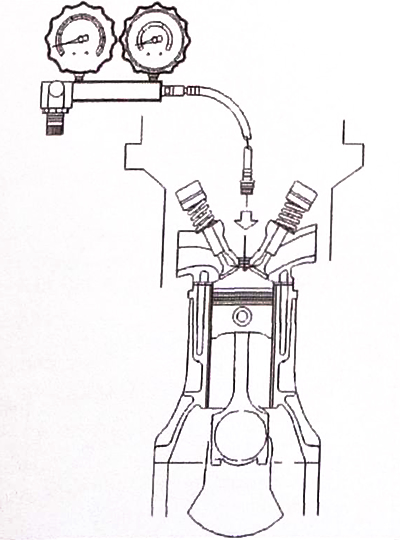
Using this method, you can measure the total amount of leakage from the engine cylinders and determine its location. A similar test can be done with a compression tester by injecting oil into the cylinder. However, this can cause carbon deposits to form. The result will not always be conclusive or accurate.
Verification method
1. The engine must be warmed up to operating temperature so that the thermostat opens.
2. The piston in the cylinder being tested must be set at top dead center at the compression stage.
3. The measured air pressure is connected to the corresponding cylinder via an adapter installed in the spark plug/preheater recess.
4. The gauge is used to determine the size of the leak from the cylinder.
This is a pressure sensor with a regulator, it shows the amount of leakage expressed as a percentage, which allows you to determine the severity of any malfunction.
Troubleshooting
The source of the leak can be detected by analyzing the sound at the following points.
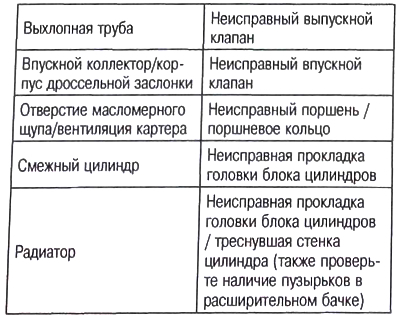
A technical stethoscope or rubber hose can be used as listening devices.
Note: Leakage exists in the piston rings even in a perfectly good engine. This is the only place where a small leak is allowed.
If a leak is detected that is suspected to be coming from the valve train, first check that the piston in the corresponding cylinder is at top dead center (TDC).
Then try to set the piston just before top dead center and repeat the check.
The measurement results of repeated leak tests on the same engine usually differ from each other.
This is due to changes in engine coolant temperature and the piston not reaching exactly the same position as in the previous check and depends on the amount of oil on the piston rings at the time of the check.