
English Русский
Български
Беларускі
Український
Српски
Hrvatski
Română
Polski
Slovenský
Magyar
Bookmark Articles Sitemap Contacts
Company Hyundai Company Opel Company Skoda Company Kia Company Mitsubishi Company LADA Company Audi
PeugeotBook.ru


Series 100   Series 200   Series 300   400-500   Series 600   Crossovers   Others
 
Peugeot 206 (1998-2012) Peugeot 207 (2006-2014)

Compression measurement (Peugeot 207)

  • Main
  • 20X
  • Peugeot 207 (2006-2014)
  • Power unit
  • Engine repair
  • Compression measurement
0
Note: Compression data for various engines is given in the chapter "Technical characteristics of petrol and diesel engines". To carry out the check, you will need a compression tester and a spark plug/preheater simulator (adapter).
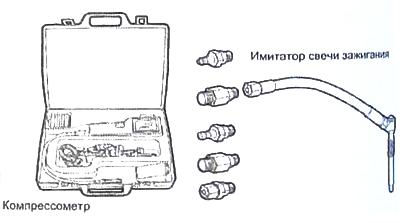

Note: Compression data for various engines is given in the chapter «Technical characteristics of…


Measure the loss of compression in each cylinder at the top meter point (the average difference between cylinders should not exceed 20%).

Note: A large loss of compression will cause noise or air bubbles in the cooling system. If the value is incorrect, localizing the noise of air leakage will allow you to locate the faulty part using a technical stethoscope or rubber hose (see the table "Troubleshooting" in Chapter "Checking for a cylinder leak").


Examination


Attention: The check is performed on a cold engine.


Original can be viewed at [www.PeugeotBook.ru]

After turning off the ignition: wait 15 minutes before disconnecting the battery to ensure that the "learning" results of the various ECUs are memorized.

Disconnect the battery.

Disconnect the engine control unit.

Remove the spark plugs or glow plugs (see the corresponding operation).

Reconnect the battery.

Make sure the starter engine speed is correct (minimum speed value): 2500 rpm.


Install the spark plug simulator on cylinder No.1 and tighten to 10 Nm.

Note: Use a mirror to connect the flexible hose of the compression tester to the spark plug simulator.


Connect the compression tester and the simulator.

Connect the negative battery terminal.

Turn on the starter for 10 seconds (with the engine control unit switched off).

The pressure in the cylinder should be 20±5 bar (for a new engine).

Disconnect the measuring devices.

Check cylinders #2, #3 and #4 in a similar manner.

Note: The difference between the two cylinders should not exceed 5 bar. Hold the pressure gauge down at the end of the compression stroke.


Caution: If the compression readings are too low, check the air filter and cylinder head gasket before checking the engine for cylinder leaks.


Disconnect the battery.

Reinstall the spark plugs or glow plugs (see the corresponding operation).

Connect the engine control unit.

Reconnect the battery.

Perform vehicle diagnostics.
This article is available at russian, bulgarian, belarusian, ukrainian, serbian, croatian, romanian, polish, slovak, hungarian
Article reviewed by editor: Matveev Demid
Share information:
Previous
Peugeot 207: Engine repair
Next

Checking for a cylinder leak
Conditions for cleaning and reassembling the internal combustion…
Cooling system test data (all engines)
Lubrication system test data (all engines)
Oil pressure check procedure (petrol engines EP3, EP6)
Oil Pressure Check Procedure (EP6DT Petrol Engines)
Oil Pressure Check Procedure (Diesel Engines)
See similar information for other Peugeot models

➨ Compression test — description and interpretation Peugeot 106 (1991-2003)
➨ Checking the compression in the engine cylinders Peugeot 307 (2001-2008)
➨ Checking the compression in the cylinders Peugeot 405 (1987-1997)
➨ Voltage measurement Peugeot 605 (1989-2000)
➨ Compression — check Peugeot 806 (1994-2002)
Link to this article in different formats
Comments and feedback from visitors
No comments yet


Add two numbers 15 + 42


Peugeot 207 (2006-2014) 
  • General information
  • Car care
  • Governing bodies
  • Driving and operation
  • Power unit
  • Engine characteristics
  • Engine repair
  • Cooling system
  • Lubrication system
  • Ignition system
  • Control system (gasoline)
  • Fuel system (gasoline)
  • Control system (diesel)
  • Transmission
  • Clutch
  • Mechanical gearbox
  • Automatic gearbox
  • Drive shafts
  • Chassis, running gear
  • Car suspension
  • Steering
  • Brake system
  • Body and interior
  • Exterior (external elements)
  • Interior (internal elements)
  • Heating and air conditioning
  • Electrical equipment
  • Equipment and devices
  • Headlights and lighting
  • Power devices
  • Electrical circuits
Peugeot 206 (1998-2012) 
  • General information
  • User manual
  • Maintenance
  • Power unit
  • Gasoline engines
  • Diesel engines
  • Diesel power system
  • Engine management system
  • Transmission
  • Clutch
  • Mechanical gearbox
  • Automatic gearbox
  • Drive shafts
  • Chassis, running gear
  • Front suspension
  • Rear suspension
  • Steering
  • Brake system
  • Body and interior
  • Body elements
  • Doors, locks and windows
  • Electrical equipment
  • Equipment and devices
  • Electrical circuits
PeugeotBook.ru © 2018–2026 | Mobile version | Sitemap: EN BG BY UA RS HR RO PL SK HU | Write message | Site search | Add to bookmarks | Peugeot owners
106 (1991-2003) | 206 (1998-2012) | 207 (2006-2014) | 305 (1977-1989) | 306 (1993-2002) | 307 (2001-2008) | 405 (1987-1997) | 406 (1995-2004) | 605 (1989-2000) | Partner-I (1996-2008) | Eurovans-807 (2002-2014) | Eurovans-806 (1994-2002) | J5 (1981-1993) |
Cookies are used to ensure the correct display of pages on the site.