English Русский
Български
Беларускі
Український
Српски
Hrvatski
Română
Polski
Slovenský
Magyar
Bookmark Articles Sitemap Contacts
Company Hyundai Company Opel Company Skoda Company Kia Company Mitsubishi Company LADA Company Audi
PeugeotBook.ru


Series 100   Series 200   Series 300   400-500   Series 600   Crossovers   Others
 
Peugeot 305 (1977-1989) Peugeot 306 (1993-2002) Peugeot 307 (2001-2008)

Front Parking Lights and Direction Indicators — bulb replacement (Peugeot 305)

  • Main
  • 30X
  • Peugeot 305 (1977-1989)
  • Electrical equipment
  • Headlights and lighting
  • Front Parking Lights and Direction Indicators — bulb replacement
0
Table of contents: Replacing front parking light/turn…🠇 Side turn signal repeaters -…🠇
1. The front parking lights and turn signal lamps are located on both sides of the car under removable plastic lenses.

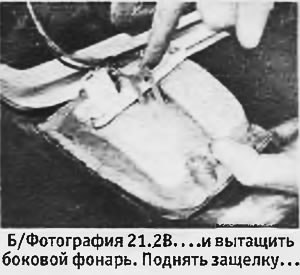
2. To replace the lamp, unscrew the upper and lower lens mounting screws and pull the lens out of its mounts. Lift the latch and pull out the socket containing the two bulbs. Each bulb is a single-filament, bayonet-type bulb, and to remove it, simply press down on the bulb and turn it counterclockwise. The lamp is installed in reverse order (see photos).
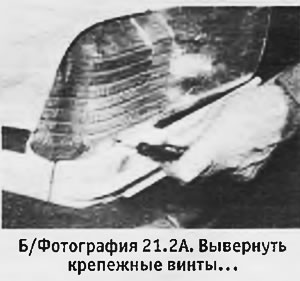
2. To replace the lamp, unscrew the upper and lower lens mounting screws and pull the lens out of…

2. To replace the lamp, unscrew the upper and lower lens mounting screws and pull the lens out of…


3. When installing the lens, be careful not to overtighten its mounting screws, as this may crack the plastic. Upon completion, check the operation of the lamps.


Note: If the direction indicators do not work and the situation does not change after replacing the bulbs, the cause of the malfunction may be in the light switch shown in B/Figure 11.7.


Replacing front parking light/turn signal bulbs on models produced since 1983.


1. Remove the headlight on the desired side.

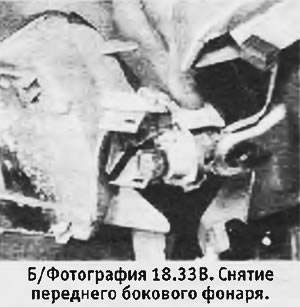
2. Press the clamp (or clamps), securing the side light and remove the light (see photos).
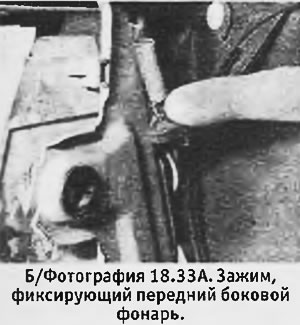
2. Press the clamp (or clamps), securing the side light and remove the light (see photos).

You can find the original on the page: www.PEUGEOTBOOK.ru

3. Remove the socket and replace the lamp. Install the socket, side light and headlight in place.

Side turn signal repeaters - description


1. Side turn signal repeaters are installed on the latest models and work in conjunction with the turn signals.

2. The side repeaters are press-fitted into the front fenders, and if a bulb burns out, the entire repeater assembly must be replaced.
This article is available at russian, bulgarian, belarusian, ukrainian, serbian, croatian, romanian, polish, slovak, hungarian
Article reviewed by editor: Ostrovsky Fedor
Share information:
Previous
Peugeot 305: Headlights and lighting
Next

Rear Combination Light — replacing bulbs
Dimmed (daytime) low beam headlights
Load-sensing headlight range control (Estate models) —…
Headlights — adjustment
Headlights — removal, replacement of bulbs and installation
Rear license plate light bulbs — removal and installation
Interior Lighting Lamps — removal and installation
See similar information for other Peugeot models

➨ Front brake pad check Peugeot 106 (1991-2003)
➨ Replacing the bulb in the direction indicators Peugeot 207 (2006-2014)
➨ External lighting (direction indicators and brake lights) Peugeot 405 (1987-1997)
➨ Signal lights Peugeot 605 (1989-2000)
➨ Direction indicator and hazard warning lights Peugeot 806 (1994-2002)
Link to this article in different formats
Comments and feedback from visitors
No comments yet


Add two numbers 32 + 35


Peugeot 307 (2001-2008) 
  • User manual
  • Keys, doors and alarm
  • Controls and instruments
  • Driving and operation
  • Maintenance
  • Power unit
  • Petrol engines TU3 and TU5
  • Petrol engines EW10
  • Diesel engines DV10
  • Diesel engines DW10
  • Transmission
  • Clutch and drive shafts
  • Mechanical gearbox
  • Automatic gearbox
  • Chassis, running gear
  • Front suspension
  • Rear suspension
  • Steering
  • Brake system
  • Body and interior
  • Exterior (external elements)
  • Interior (internal elements)
  • Doors, locks and windows
  • Heating and air conditioning
  • Electrical equipment
  • Equipment and devices
  • Power devices
  • Airbags
  • Electrical circuits
Peugeot 306 (1993-2002) 
  • General information
  • Introduction to manual
  • Specifications
  • Gasoline engine
  • Engine repair
  • Lubrication system
  • Cooling system
  • Fuel injection
  • Ignition system
  • Diesel engine
  • Engine repair
  • Lubrication system
  • Cooling system
  • Fuel injection
  • Transmission
  • Clutch
  • Gearbox
  • Drive shafts
  • Chassis, running gear
  • Steering system
  • Front suspension
  • Rear suspension
  • Brake system
  • Electrical equipment
  • Power devices
  • Electrical circuits
Peugeot 305 (1977-1989) 
  • General information
  • Maintenance
  • Power unit
  • Gasoline engines
  • Diesel engines
  • Cooling system (gasoline)
  • Cooling system (diesel)
  • Fuel system (gasoline)
  • Fuel system (diesel)
  • Ignition system
  • Transmission
  • Clutch
  • Mechanical gearbox BB8
  • Mechanical gearbox BE1
  • Automatic gearbox ZF4
  • Shafts, hubs and wheels
  • Chassis, running gear
  • Brake system
  • Car suspension
  • Steering
  • Body and interior
  • Exterior (external elements)
  • Interior (internal elements)
  • Electrical equipment
  • Equipment and devices
  • Headlights and lighting
  • Power devices
  • Electrical circuits
  • Wiring diagrams (diesel)
PeugeotBook.ru © 2018–2026 | Mobile version | Sitemap: EN BG BY UA RS HR RO PL SK HU | Write message | Site search | Add to bookmarks | Peugeot owners
106 (1991-2003) | 206 (1998-2012) | 207 (2006-2014) | 305 (1977-1989) | 306 (1993-2002) | 307 (2001-2008) | 405 (1987-1997) | 406 (1995-2004) | 605 (1989-2000) | Partner-I (1996-2008) | Eurovans-807 (2002-2014) | Eurovans-806 (1994-2002) | J5 (1981-1993) |
Cookies are used to ensure the correct display of pages on the site.