
English Русский
Български
Беларускі
Український
Српски
Hrvatski
Română
Polski
Slovenský
Magyar
Bookmark Articles Sitemap Contacts
Company Hyundai Company Opel Company Skoda Company Kia Company Mitsubishi Company LADA Company Audi
PeugeotBook.ru


Series 100   Series 200   Series 300   400-500   Series 600   Crossovers   Others
 
Peugeot 305 (1977-1989) Peugeot 306 (1993-2002) Peugeot 307 (2001-2008)

Fuses — description, location, and replacement (Peugeot 307)

  • Main
  • 30X
  • Peugeot 307 (2001-2008)
  • Electrical equipment
  • Equipment and devices
  • Fuses — description, location, and replacement
0
Fuses are used to break the circuit when the current reaches a certain value, and also to protect elements and wires that could be damaged by too much current. A sudden increase in current is usually caused by a fault in the circuit, most often a short circuit.

There are two electrical fuse boxes located in the instrument panel (from the driver's side) and in the engine compartment.
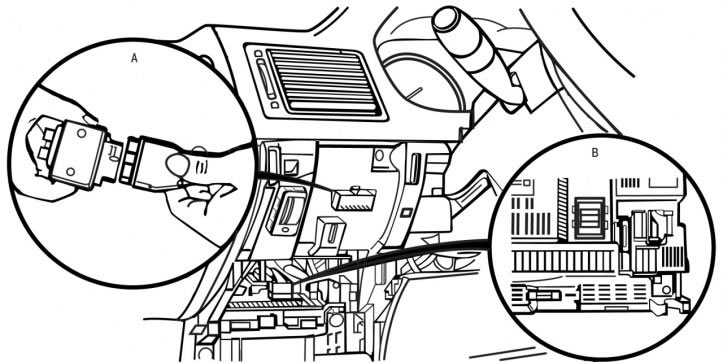
Figure 9.1. Connection location of the IB12 interface unit and the TB12 controller (A) to the…

Figure 9.1. Connection location of the IB12 interface unit and the TB12 controller (A) to the 16-pin diagnostic connector and the location of the fuse box (B)


Spare fuses and a special tweezers for removing them are located on the inner surface of the fuse box cover located in the instrument panel (see Figure 9.1).

If the fuse is blown, it means that the wire connecting the fuse contacts is broken.

Before removing a fuse, turn off the corresponding circuit (or ignition), then remove the fuse from the contacts.

Before replacing a blown fuse, it is necessary to identify and eliminate the cause of the malfunction. The fuse numbers are marked on the fuse box panel.

Always replace a fuse with another fuse of the same rating. Each fuse has the value of the protected current indicated on it. In addition, the color of the fuse body corresponds to the value of the protected current. The correspondence between the fuse color and the current value is given in the table. 9.2.
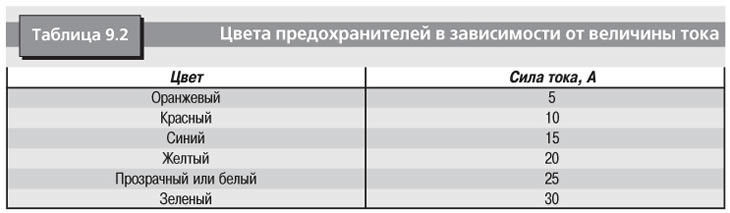


Always replace a fuse with another fuse of the same rating. Each fuse has the value of the…

Never replace a fuse more than once without determining the cause of its blown fuse.

If the installed fuse blows again, check the electrical circuit protected by the fuse.

In most cases, the cause of the malfunction is a short circuit caused by poor insulation. If the fuse protects multiple circuits, try to find the circuit that is causing the fuse to blow by turning on each circuit in turn (if possible).

Never replace a fuse with a jumper wire, as this may cause serious damage to the vehicle's electrical circuit.
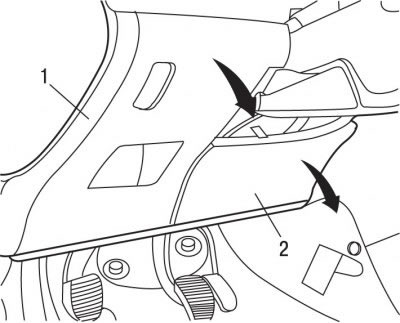
Figure 9.5. Fuse box location: 1 - lid; 2 - trim panel

Figure 9.5. Fuse box location: 1 - lid; 2 - trim panel


To access the fuses located in the instrument panel, remove cover 1 (figure 9.5), by releasing it from the clips and pulling it down, you will gain access to the fuse box, 16-pin diagnostic connector and junction box.
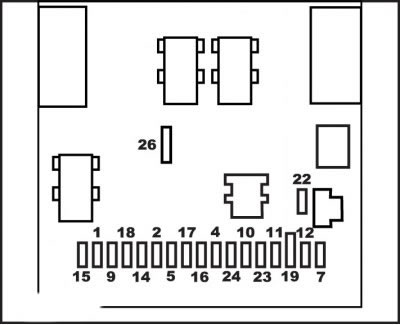


Figure 9.6. Location of fuses on the fuse box in the instrument panel

Figure 9.6. Location of fuses on the fuse box in the instrument panel


The location of the fuses in the fuse box in the instrument panel is shown in the figure 9.6.

The numbers, rated current and circuits protected by the fuses located in the instrument panel are given in the table. 9.3.
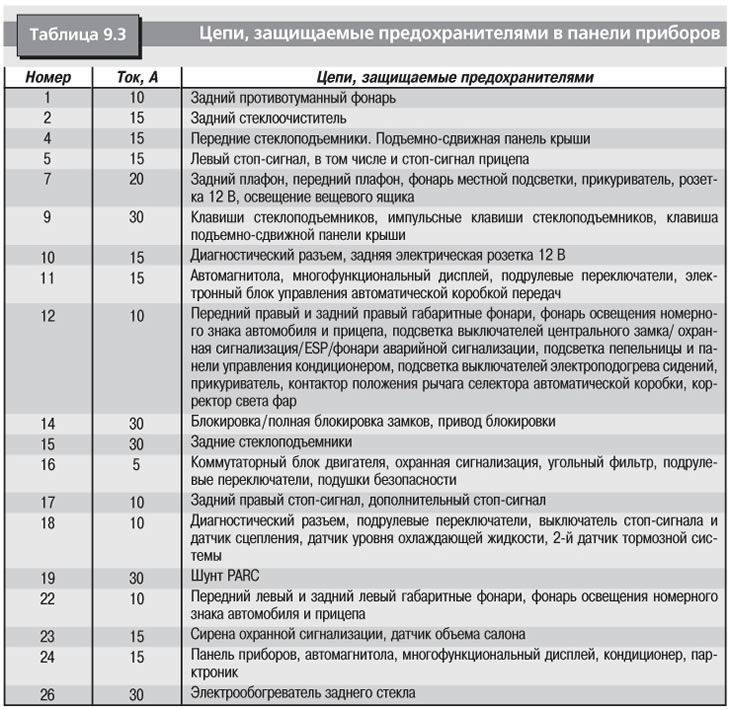
The numbers, rated current and circuits protected by the fuses located in the instrument panel are…

Circuits protected by fuses in the instrument panel


To access the fuses located in the engine compartment (the fuse box is located on the left in the engine compartment, near the battery), remove the housing and cover from the fuse box.

After completing the work, carefully close the fuse box cover and replace the housing.
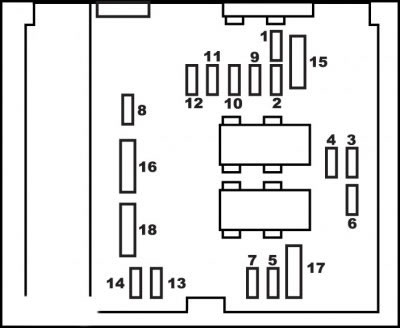
Figure 9.7. Location of fuses on the fuse box in the engine compartment

Figure 9.7. Location of fuses on the fuse box in the engine compartment


Data published on the website www.PEUGEOTBOOK.ru

The location of the fuses in the fuse box in the engine compartment is shown in the figure 9.7.

The numbers, rated current and circuits protected by the fuses located in the engine compartment are given in the table. 9.4.
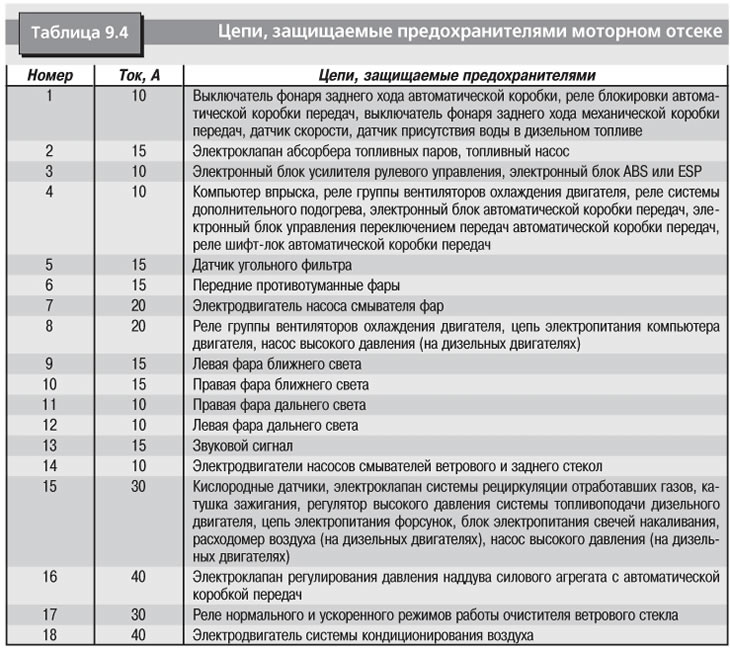
The numbers, rated current and circuits protected by the fuses located in the engine compartment…

High current fuses provide additional protection for electrical equipment circuits. All work on them must be carried out by qualified specialists of the Peugeot service network.

The numbers, rated current and circuits protected by high current fuses are given in Table. 9.5.
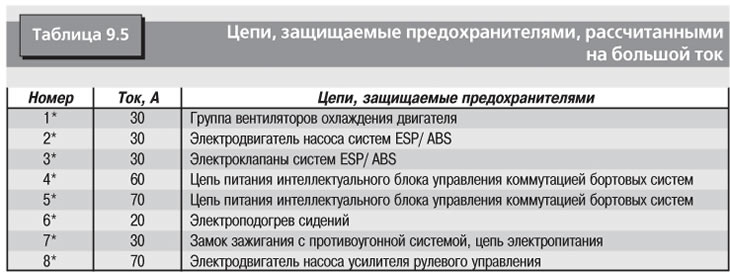
The numbers, rated current and circuits protected by high current fuses are given in Table. 9.5.

Please note: Fuse ratings and electrical circuits may change from year to year.
This article is available at russian, bulgarian, belarusian, ukrainian, serbian, croatian, romanian, polish, slovak, hungarian
Article reviewed by editor: Sidorov Timofey
Share information:
Previous
Peugeot 307: Equipment and devices
Next

Detecting faults in electrical circuits
Electrical circuits — general information
General information about electrical equipment
Intelligent Switch Box — removal and installation
Headlights — removal and installation
Replacing the rear light
Replacing the high brake light
Replacing the license plate light
See similar information for other Peugeot models

➨ Component location — diesel models Peugeot 106 (1991-2003)
➨ Fuses — location and replacement Peugeot 206 (1998-2012)
➨ List of fuses Peugeot 406 (1995-2004)
➨ Fuses — General Information Peugeot 605 (1989-2000)
➨ Location of symbols on electrical diagrams Peugeot 806 (1994-2002)
Link to this article in different formats
Comments and feedback from visitors
No comments yet


Add two numbers 23 + 25


Peugeot 307 (2001-2008) 
  • User manual
  • Keys, doors and alarm
  • Controls and instruments
  • Driving and operation
  • Maintenance
  • Power unit
  • Petrol engines TU3 and TU5
  • Petrol engines EW10
  • Diesel engines DV10
  • Diesel engines DW10
  • Transmission
  • Clutch and drive shafts
  • Mechanical gearbox
  • Automatic gearbox
  • Chassis, running gear
  • Front suspension
  • Rear suspension
  • Steering
  • Brake system
  • Body and interior
  • Exterior (external elements)
  • Interior (internal elements)
  • Doors, locks and windows
  • Heating and air conditioning
  • Electrical equipment
  • Equipment and devices
  • Power devices
  • Airbags
  • Electrical circuits
Peugeot 306 (1993-2002) 
  • General information
  • Introduction to manual
  • Specifications
  • Gasoline engine
  • Engine repair
  • Lubrication system
  • Cooling system
  • Fuel injection
  • Ignition system
  • Diesel engine
  • Engine repair
  • Lubrication system
  • Cooling system
  • Fuel injection
  • Transmission
  • Clutch
  • Gearbox
  • Drive shafts
  • Chassis, running gear
  • Steering system
  • Front suspension
  • Rear suspension
  • Brake system
  • Electrical equipment
  • Power devices
  • Electrical circuits
Peugeot 305 (1977-1989) 
  • General information
  • Maintenance
  • Power unit
  • Gasoline engines
  • Diesel engines
  • Cooling system (gasoline)
  • Cooling system (diesel)
  • Fuel system (gasoline)
  • Fuel system (diesel)
  • Ignition system
  • Transmission
  • Clutch
  • Mechanical gearbox BB8
  • Mechanical gearbox BE1
  • Automatic gearbox ZF4
  • Shafts, hubs and wheels
  • Chassis, running gear
  • Brake system
  • Car suspension
  • Steering
  • Body and interior
  • Exterior (external elements)
  • Interior (internal elements)
  • Electrical equipment
  • Equipment and devices
  • Headlights and lighting
  • Power devices
  • Electrical circuits
  • Wiring diagrams (diesel)
PeugeotBook.ru © 2018–2026 | Mobile version | Sitemap: EN BG BY UA RS HR RO PL SK HU | Write message | Site search | Add to bookmarks | Peugeot owners
106 (1991-2003) | 206 (1998-2012) | 207 (2006-2014) | 305 (1977-1989) | 306 (1993-2002) | 307 (2001-2008) | 405 (1987-1997) | 406 (1995-2004) | 605 (1989-2000) | Partner-I (1996-2008) | Eurovans-807 (2002-2014) | Eurovans-806 (1994-2002) | J5 (1981-1993) |
Cookies are used to ensure the correct display of pages on the site.