Table of contents: Symptoms (Sport and Snow indicator…🠇 Delay in switching 🠇 When pressing the brake pedal, the…🠇 Other malfunctions (fuel…🠇 Switching to emergency mode 🠇 Teleloading 🠇 Updating the working fluid wear…🠇 Telecoding 🠇 Initializing the Pedal 🠇 Error related contexts 🠇
Attention: Before starting the gearbox repair, perform diagnostics by reading errors from the memory of the engine electronic control unit.
Note: If there is any damage or malfunction of the automatic transmission, check the oil level and quality.
Error 1. Ignition + power supply
"Sport" and "Snow" indicator lights flash: yes.

Error 2. Computer
"Sport" and "Snow" indicator lights flash: yes.
Clear the error and check that the error does not reappear, otherwise perform the test with a new electronic control unit.
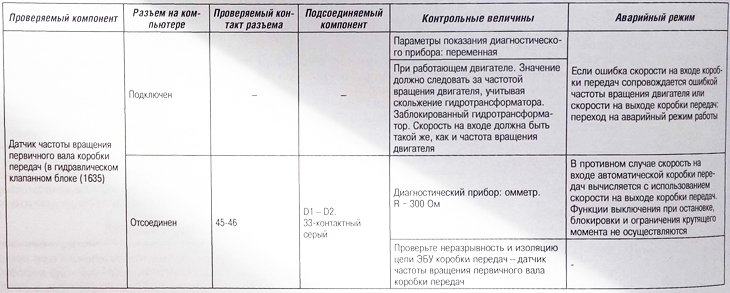
Error 3. Automatic transmission input speed (turbine speed)
"Sport" and "Snow" indicator lights flash: yes.
The electronic control unit checks the consistency of information regarding engine speed and gearbox input and output speeds.
If the gearbox input speed error is stored in memory, the gearbox output speed error is not stored.
Error 4. Automatic transmission output speed (car speed)
"Sport" and "Snow" indicator lights flash: yes.
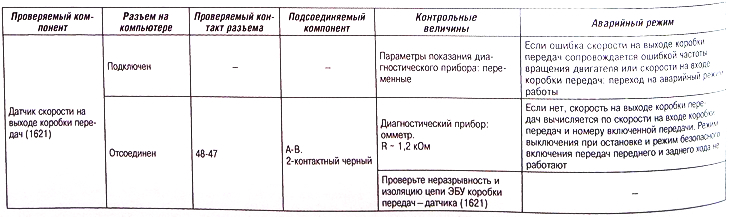
The ECU checks the consistency of information regarding engine speed and gearbox input and output speeds.
If the vehicle speed error is stored in memory, then any possible speed error at the gearbox input will not be stored.
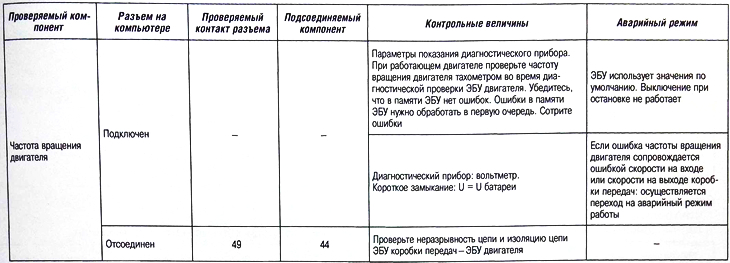
Error 5. Engine speed
"Sport" and "Snow" indicator lights flash: yes.
The ECU checks the consistency of information regarding engine speed and gearbox input and output speeds.
Error 6. "Brake light" switch
Please note: There is only one switch.
"Sport" and "Snow" indicator lights flash: no.

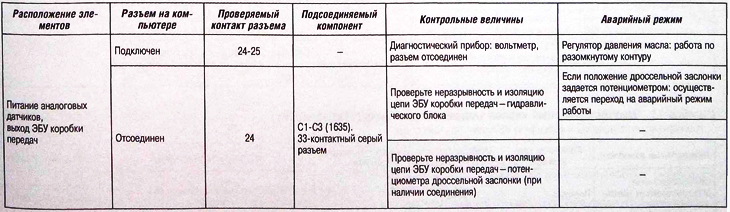
Error 7. Power supply for temperature and pressure sensors
"Sport" and "Snow" indicator lights flash: no.
The following analog sensors are supplied with a common voltage source distributed across individual connector contacts:
- oil temperature sensor;
- oil level and temperature sensor.
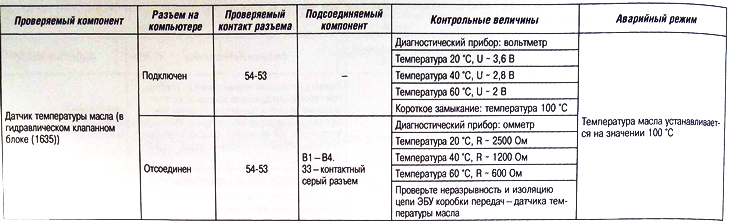
Error 8. Oil temperature
"Sport" and "Snow" indicator lights flash: no.
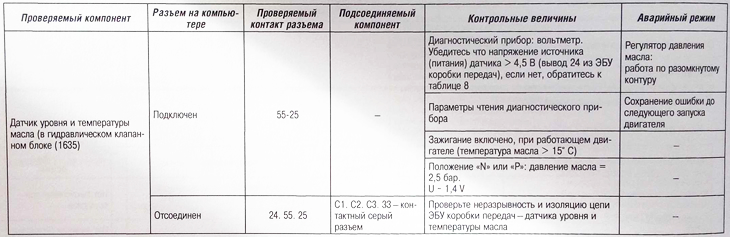
Error 9. Oil pressure
"Sport" and "Snow" indicator lights flash: yes.
The pressure sensor supplies the transmission ECU with voltage proportional to the oil pressure.
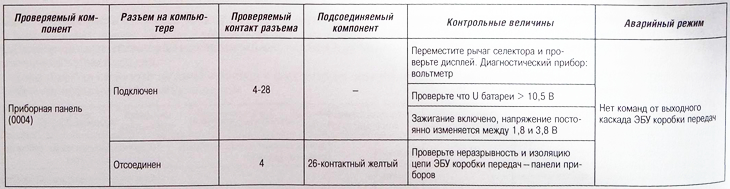
Error 10. Output to the instrument panel (low speed signal)
"Sport" and "Snow" indicator lights flash: yes.
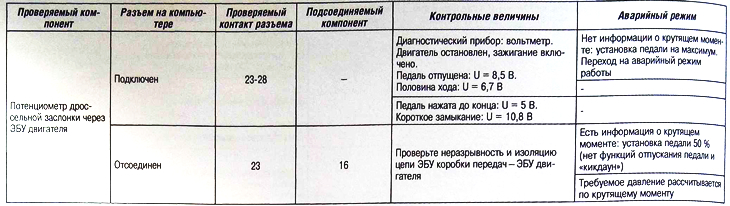
Error 11. Pressure modulation solenoid valve (EVM pressure)
"Sport" and "Snow" indicator lights flash: yes.

See the sequence of operations: location of the electromagnetic valves in the hydraulic block.
Error 12. Electromagnetic locking valve (EVM bypass)
"Sport" and "Snow" indicator lights flash: yes.
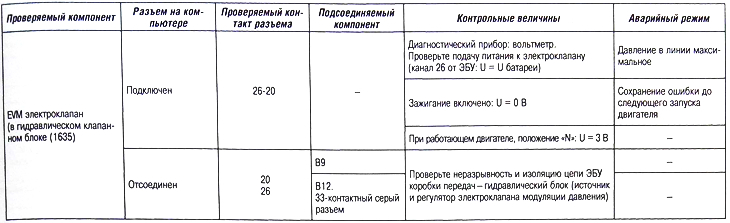
Note: See the sequence of operations: location of the solenoid valves in the hydraulic block.
Error 13. Torque limitation
"Sport" and "Snow" indicator lights flash: no.
Note: Torque limitation does not occur if the oil temperature is below a certain value. If the vehicle is equipped with a gasoline engine, torque limitation is performed by adjusting the ignition timing.
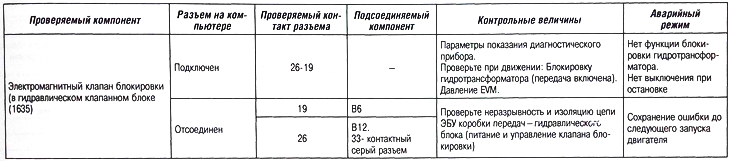
Error 14. Throttle potentiometer via engine ECU
"Sport" and "Snow" indicator lights flash: yes.
Errors in the engine ECU memory should be processed first.
Check if the error was present in the transmission ECU memory as intermittent.
If there are errors in the engine ECU, it informs the gearbox ECU, and the diagnostic tool displays the message: "INJ throttle potentiometer error".
Otherwise, the diagnostic tool displays the message: "Throttle Potentiometer Communication Error".

Error 15. Solenoid valves 1-6
"Sport" and "Snow" indicator lights flash: yes.
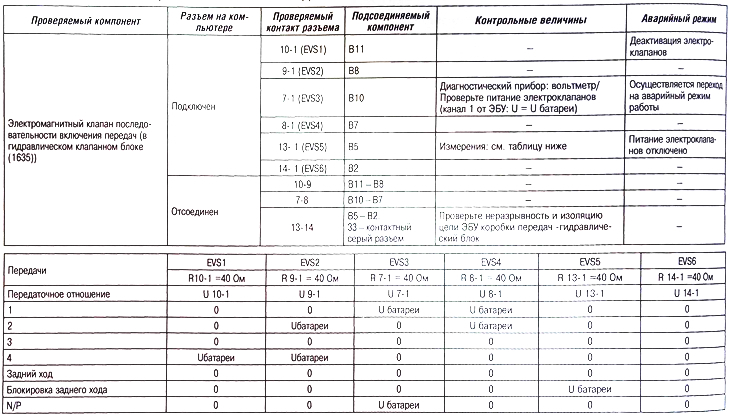
Note: See the sequence of operations: location of the solenoid valves in the hydraulic block.
Error 16. Solenoid valve for flow through heat exchanger
"Sport" and "Snow" indicator lights flash: yes.

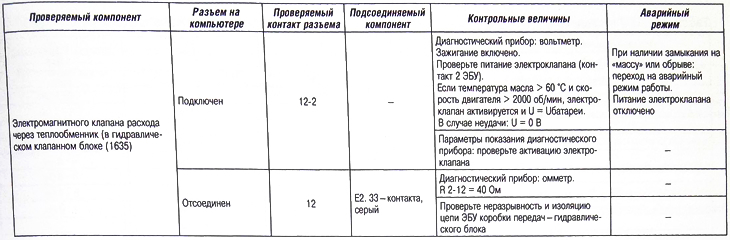
Error 17. Selector lever lock
"Sport" and "Snow" indicator lights flash: no.
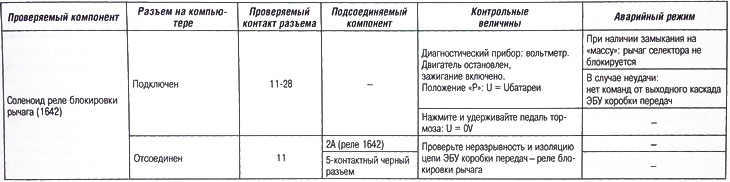
Error 18. Multi-function switch
The "Sport" and "Snow" indicator lights are flashing:
- yes, in an unstable or prohibited position;
- no, in an intermediate position.

Table 1 (ECU is connected)
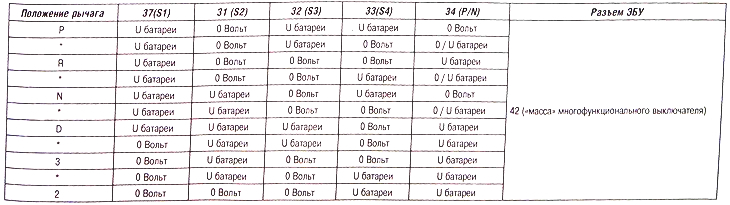
* Intermediate part.
Table 1 (ECU is connected)
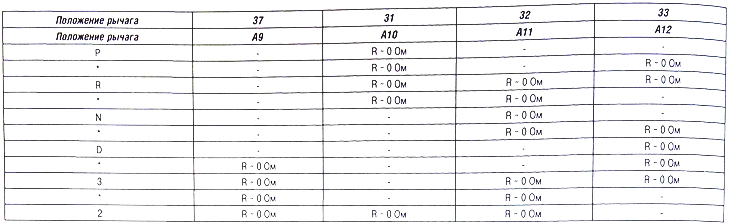
* Intermediate part.
Check the continuity of the circuit A4 - body ground.
Check the continuity and insulation of the A8 circuit (electrohydraulic connector) — 34 (Automatic transmission ECU).
Symptoms (Sport and Snow indicator lights flashing)
Simultaneous flashing of the "Sport" and "Snow" indicators means the following:
- overheating of the working fluid of the gearbox;
- aging and contamination of the working fluid;
- disconnection of the transmission ECU from the instrument panel;
- accelerator pedal "learning" not completed;
- the computer is inactive (The ECU is faulty);
- request from diagnostic tool (checking actuators).
Flashing of the alarms may also be caused by changes in the following factors:
- oil pressure;
- throttle position (via potentiometer or engine ECU);
- gearbox input shaft speed;
- gearbox output shaft speed;
- engine speed;
- operation of the electromagnetic valve of the flow through the heat exchanger;
- operation of the electromagnetic pressure modulation valve;
- maximum pressure adjustment;
- operation of the electromagnetic valve of gear shifting sequence;
- eCU operation or ECU power failure;
- operation of the multi-function switch.
Delay in switching
A delay in switching can be caused by changes in the following factors:
- gearbox input shaft speed;
- gearbox output shaft speed;
- engine speed;
- torque smoothing;
- torque information from the engine's electronic control unit.
When pressing the brake pedal, the lever lock in the "P" position does not disengage
The selector lever lock disabling function in position "P" does not work due to a malfunction:
- brake system contact sensor;
- lever lock relay.
Other malfunctions (fuel consumption, comfort, etc.)
Other malfunctions may be caused by:
- failure in the control of the electromagnetic valve controlling the heat exchanger flow (short circuit to "+");
- malfunction in the control of the electromagnetic valve of blocking modulation;
- faulty connection of the "kickdown" mode switch;
- information about the temperature of the transmission fluid.
Switching to emergency mode
Note: Only 3rd gear and reverse gear are available in this mode.
Clutch slippage when starting off. Emergency mode with the possibility of locking the torque converter may be caused by a malfunction in the operation of:
- electromagnetic valves of gear shifting sequence;
- throttle valve if torque information is supported by the engine ECU;
- electromagnetic pressure modulation valve;
- multifunctional switch;
- electromagnetic valve flow through heat exchanger;
- incorrect adjustment of the main fluid pressure;
- not performing "learning" of the accelerator pedal.
The emergency mode without locking of the torque converter can be caused by:
- if the gearbox input speed error is accompanied by an engine speed or gearbox output speed error;
- if the gearbox output speed error is accompanied by an engine speed or gearbox input speed error;
- Automatic transmission ECU.
Teleloading
Updating the gearbox ECU program using TeleDownload: follow the diagnostic tool procedure.
The teleloader provides software updates for the automatic transmission ECU or its adaptation to engine ECU modifications.
Before teleloading, it is necessary to record the readings of the working fluid wear counter available in the automatic transmission ECU.
After teleloading, you need to:
- remove errors;
- perform pedal initialization;
- perform self-adaptation initialization;
- perform programming (if necessary);
- enter the previously taken reading of the working fluid wear counter;
- perform road tests.
Note: Every time the automatic transmission ECU software is updated, the engine ECU software must also be updated.
Updating the working fluid wear counter readings
PROXIA station: access to reading and entering the readings of the working fluid wear counter is provided through the menu: "Telecoding (push button system) / working fluid wear counter". The working fluid wear counter readings change in increments of 2750.
LEXIA station - EL.IT unit: access to reading and entering the working fluid wear counter readings is provided through the menu: "Working fluid wear counter".
Setting the readings of the working fluid wear counter is achieved by directly entering the counter numbers.
Telecoding
ECU programming procedure: Follow the diagnostic tool procedure.
A new or newly programmed ECU is always configured with the following options:
- selector lever lock;
- without OBD output (l4 emission reduction system).
If the ECU is intended for installation on a vehicle equipped with the L4 emission reduction system or not equipped with the selector lever lock system: perform the programming operation.
Initializing the Pedal
The pedal must be initialized in the following cases:
- automatic transmission ECU replacement;
- automatic transmission replacement;
- teleloading software into the ECU;
- replacing or adjusting the accelerator pedal cable;
- replacing the throttle potentiometer.
Error related contexts
For each error stored in memory, the following information is displayed:
- error type (temporary or permanent);
- error mode (short circuit or open circuit);
- three related variables that are saved in memory when an error occurs.
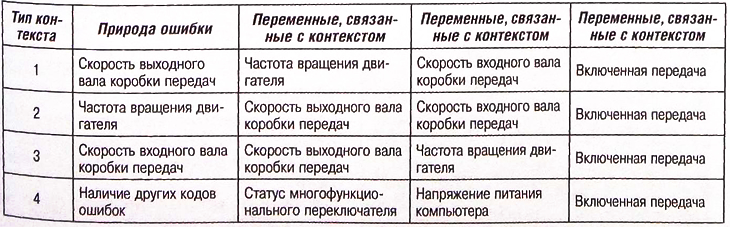
There are four types of context. When multiple errors with the same type of associated context are stored in memory, only the context of the last error is output.
Table of context types