
English Русский
Български
Беларускі
Український
Српски
Hrvatski
Română
Polski
Slovenský
Magyar
Bookmark Articles Sitemap Contacts
Company Hyundai Company Opel Company Skoda Company Kia Company Mitsubishi Company LADA Company Audi
PeugeotBook.ru


Series 100   Series 200   Series 300   400-500   Series 600   Crossovers   Others
 
Peugeot 305 (1977-1989) Peugeot 306 (1993-2002) Peugeot 307 (2001-2008)

General description of the cooling system (Peugeot 305)

  • Main
  • 30X
  • Peugeot 305 (1977-1989)
  • Power unit
  • Cooling system (gasoline)
  • General description of the cooling system
0
The cooling system is of the thermosiphon type and has an auxiliary water pump. The pressure in the system is achieved by means of a valve in the radiator cap. The main components of the system are the radiator, water pump, thermostat, cooling fan, heater and connecting hoses. The system works on the following principle.

Cold coolant from the bottom of the radiator is pumped by a pump into the water jacket channels of the block and cylinder head, where it absorbs heat from the combustion chambers and moving parts of the engine, then flows into the upper part of the radiator. As the liquid passes through the radiator, it is cooled by the air flow (arising from the movement of the machine and, when necessary, from the fan),.and the process starts again.

To speed up engine warm-up and maintain its correct operating temperature, a thermostat is installed on the outlet of the cooling system connecting the engine to the upper radiator hose. When the coolant is cold, the thermostat is closed and the coolant circulates through the engine's water jacket, returning back through the bypass channel. As the temperature of the fluid rises, the thermostat opens and fluid begins to flow into the radiator.

The system is under pressure, which helps to lower the boiling point of the coolant. This ensures optimal engine operating temperature and reduces the amount of liquid required for cooling.

Hot coolant enters the car's interior heater and also transfers heat to the carburetor and intake manifold, which facilitates the process of converting the fuel into a vaporous state.


The fan pulley has an electromagnetic drive that is activated only when the coolant temperature is high. This design ensures that the fan operates only when it is really needed, resulting in reduced noise levels and energy consumption.

Original can be viewed at: peugeotbook.ru
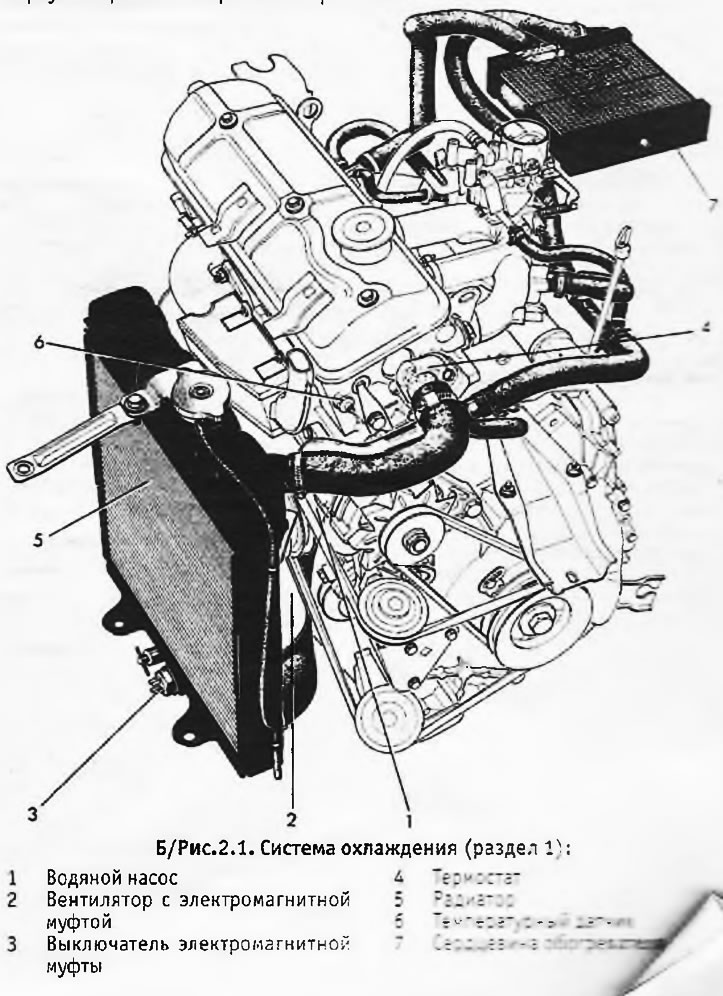
The fan pulley has an electromagnetic drive that is activated only when the coolant temperature is…


Cooling system on XU engines


1. The cooling system on XU engines differs from the cooling system used on XL and XR engines in three main ways:
  • a. The system is closed (air from the radiator is released into the expansion tank, not into the atmosphere).
  • b. The water pump is driven by the camshaft drive belt.
  • c. The radiator cooling fan is driven by an electric motor.

2. There are also minor differences in the hose routing and thermostat location. The basic procedures for working with the cooling system remain unchanged.
This article is available at russian, bulgarian, belarusian, ukrainian, serbian, croatian, romanian, polish, slovak, hungarian
Article reviewed by editor: Ostrovsky Fedor
Share information:
Previous
Peugeot 305: Cooling system (gasoline)
Next

Cooling system specification
Draining the coolant
Flushing the cooling system
Filling with coolant
Water Pump Drive Belt — removal and installation
Antifreeze mixture
See similar information for other Peugeot models

➨ Cooling system electrical switches — testing, removal and… Peugeot 106 (1991-2003)
➨ Cooling system test data (all engines) Peugeot 207 (2006-2014)
➨ Cooling system hoses Peugeot 405 (1987-1997)
➨ Cooling system — bleeding Peugeot 605 (1989-2000)
➨ Cooling, ventilation and heating system — general description Peugeot 807 (2002-2014)
Link to this article in different formats
Comments and feedback from visitors
No comments yet


Add two numbers 24 + 38


Peugeot 307 (2001-2008) 
  • User manual
  • Keys, doors and alarm
  • Controls and instruments
  • Driving and operation
  • Maintenance
  • Power unit
  • Petrol engines TU3 and TU5
  • Petrol engines EW10
  • Diesel engines DV10
  • Diesel engines DW10
  • Transmission
  • Clutch and drive shafts
  • Mechanical gearbox
  • Automatic gearbox
  • Chassis, running gear
  • Front suspension
  • Rear suspension
  • Steering
  • Brake system
  • Body and interior
  • Exterior (external elements)
  • Interior (internal elements)
  • Doors, locks and windows
  • Heating and air conditioning
  • Electrical equipment
  • Equipment and devices
  • Power devices
  • Airbags
  • Electrical circuits
Peugeot 306 (1993-2002) 
  • General information
  • Introduction to manual
  • Specifications
  • Gasoline engine
  • Engine repair
  • Lubrication system
  • Cooling system
  • Fuel injection
  • Ignition system
  • Diesel engine
  • Engine repair
  • Lubrication system
  • Cooling system
  • Fuel injection
  • Transmission
  • Clutch
  • Gearbox
  • Drive shafts
  • Chassis, running gear
  • Steering system
  • Front suspension
  • Rear suspension
  • Brake system
  • Electrical equipment
  • Power devices
  • Electrical circuits
Peugeot 305 (1977-1989) 
  • General information
  • Maintenance
  • Power unit
  • Gasoline engines
  • Diesel engines
  • Cooling system (gasoline)
  • Cooling system (diesel)
  • Fuel system (gasoline)
  • Fuel system (diesel)
  • Ignition system
  • Transmission
  • Clutch
  • Mechanical gearbox BB8
  • Mechanical gearbox BE1
  • Automatic gearbox ZF4
  • Shafts, hubs and wheels
  • Chassis, running gear
  • Brake system
  • Car suspension
  • Steering
  • Body and interior
  • Exterior (external elements)
  • Interior (internal elements)
  • Electrical equipment
  • Equipment and devices
  • Headlights and lighting
  • Power devices
  • Electrical circuits
  • Wiring diagrams (diesel)
PeugeotBook.ru © 2018–2026 | Mobile version | Sitemap: EN BG BY UA RS HR RO PL SK HU | Write message | Site search | Add to bookmarks | Peugeot owners
106 (1991-2003) | 206 (1998-2012) | 207 (2006-2014) | 305 (1977-1989) | 306 (1993-2002) | 307 (2001-2008) | 405 (1987-1997) | 406 (1995-2004) | 605 (1989-2000) | Partner-I (1996-2008) | Eurovans-807 (2002-2014) | Eurovans-806 (1994-2002) | J5 (1981-1993) |
Cookies are used to ensure the correct display of pages on the site.