
English Русский
Български
Беларускі
Український
Српски
Hrvatski
Română
Polski
Slovenský
Magyar
Bookmark Articles Sitemap Contacts
Company Hyundai Company Opel Company Skoda Company Kia Company Mitsubishi Company LADA Company Audi
PeugeotBook.ru


Series 100   Series 200   Series 300   400-500   Series 600   Crossovers   Others
 
Peugeot 305 (1977-1989) Peugeot 306 (1993-2002) Peugeot 307 (2001-2008)

Adjusting the rear suspension of a car (Peugeot 307)

  • Main
  • 30X
  • Peugeot 307 (2001-2008)
  • Chassis, running gear
  • Rear suspension
  • Adjusting the rear suspension of a car
0
To adjust the rear suspension of the car:

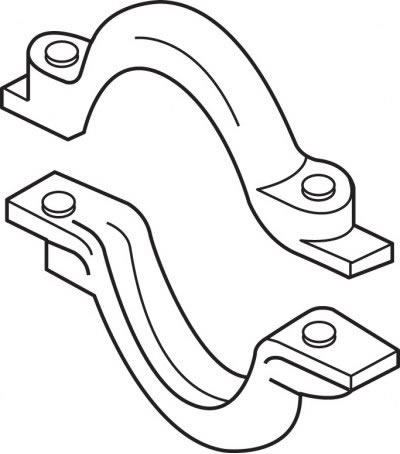
Figure 6.44. Brackets for fastening belts when measuring the middle position of the rear suspension

Figure 6.44. Brackets for fastening belts when measuring the middle position of the rear suspension

  • to measure the center position of the rear suspension, make the brackets shown in the figure 6.44. You can also use a set of PR 1713.55 clamp halves, after drilling holes in them to a diameter of 11.5 mm;
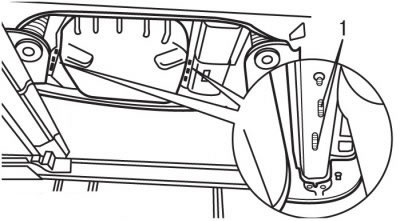
Figure 6.45. Location of bolts (1) for fastening the towing hitch
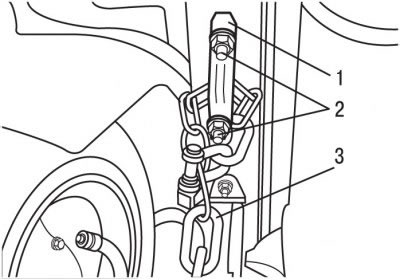
Figure 6.45. Location of bolts (1) for fastening the towing hitch


Source can be seen at Peugeotbook.ru

Figure 6.46. Location of adjustment elements: 1 - bracket; 2 - bracket mounting nuts; 3 - slings…

Figure 6.46. Location of adjustment elements: 1 - bracket; 2 - bracket mounting nuts; 3 - slings secured to the bracket


  • install the clamps or half clamps onto the bolts 1 (figure 6.45), designed for fastening the towing hitch, and secure them with nuts 2 (figure 6.46);
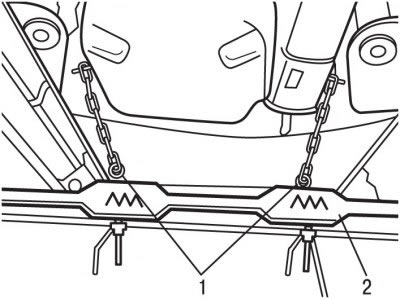
Figure 6.47. Adjusting the rear suspension of the car: 1 - crossbar; 2 - screw mechanism for…

Figure 6.47. Adjusting the rear suspension of the car: 1 - crossbar; 2 - screw mechanism for compressing springs

  • secure the crossbar 2 with screw mechanisms 1 under the lift platforms (figure 6.47) to compress the springs;
  • pass the straps with rings or slings through the brackets and secure them to the shaft of the screw mechanism for compressing the springs 2;
  • adjust the length and position of the belts so that they occupy the most vertical position when they are tensioned;
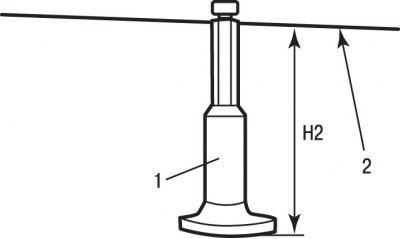
Figure 6.48. Measuring the average position of the rear suspension: 1 - measuring instrument; 2 -…

Figure 6.48. Measuring the average position of the rear suspension: 1 - measuring instrument; 2 - body edge; H2 - middle position of the suspension

  • by rotating the shaft with a screw mechanism to compress the springs, compress the suspension springs so that the vehicle body settlement on both the left and right sides is H2 (middle suspension position) between the edge of the body B (figure 6.48) and the platform floor;
  • make sure that the previously obtained H1 value when measuring the average position of the front suspension remains unchanged.
This article is available at russian, bulgarian, belarusian, ukrainian, serbian, croatian, romanian, polish, slovak, hungarian
Article reviewed by editor: Sidorov Timofey
Share information:
Previous
Peugeot 307: Rear suspension
Next

Replacing the hub assembly with the bearing and axle
Replacing the rear wheel hub
Replacing the front hinge of the rear suspension beam
Replacing the rear shock absorber
Replacing the rear suspension spring
 
See similar information for other Peugeot models

➨ Rear suspension assembly — general Peugeot 106 (1991-2003)
➨ General characteristics and tightening torques of the rear… Peugeot 207 (2006-2014)
➨ Rear suspension — design description Peugeot 405 (1987-1997)
➨ Rear wheel suspension — removal and installation Peugeot 605 (1989-2000)
➨ Rear suspension — removal and installation Peugeot 806 (1994-2002)
Link to this article in different formats
Comments and feedback from visitors
No comments yet


Add two numbers 14 + 27


Peugeot 307 (2001-2008) 
  • User manual
  • Keys, doors and alarm
  • Controls and instruments
  • Driving and operation
  • Maintenance
  • Power unit
  • Petrol engines TU3 and TU5
  • Petrol engines EW10
  • Diesel engines DV10
  • Diesel engines DW10
  • Transmission
  • Clutch and drive shafts
  • Mechanical gearbox
  • Automatic gearbox
  • Chassis, running gear
  • Front suspension
  • Rear suspension
  • Steering
  • Brake system
  • Body and interior
  • Exterior (external elements)
  • Interior (internal elements)
  • Doors, locks and windows
  • Heating and air conditioning
  • Electrical equipment
  • Equipment and devices
  • Power devices
  • Airbags
  • Electrical circuits
Peugeot 306 (1993-2002) 
  • General information
  • Introduction to manual
  • Specifications
  • Gasoline engine
  • Engine repair
  • Lubrication system
  • Cooling system
  • Fuel injection
  • Ignition system
  • Diesel engine
  • Engine repair
  • Lubrication system
  • Cooling system
  • Fuel injection
  • Transmission
  • Clutch
  • Gearbox
  • Drive shafts
  • Chassis, running gear
  • Steering system
  • Front suspension
  • Rear suspension
  • Brake system
  • Electrical equipment
  • Power devices
  • Electrical circuits
Peugeot 305 (1977-1989) 
  • General information
  • Maintenance
  • Power unit
  • Gasoline engines
  • Diesel engines
  • Cooling system (gasoline)
  • Cooling system (diesel)
  • Fuel system (gasoline)
  • Fuel system (diesel)
  • Ignition system
  • Transmission
  • Clutch
  • Mechanical gearbox BB8
  • Mechanical gearbox BE1
  • Automatic gearbox ZF4
  • Shafts, hubs and wheels
  • Chassis, running gear
  • Brake system
  • Car suspension
  • Steering
  • Body and interior
  • Exterior (external elements)
  • Interior (internal elements)
  • Electrical equipment
  • Equipment and devices
  • Headlights and lighting
  • Power devices
  • Electrical circuits
  • Wiring diagrams (diesel)
PeugeotBook.ru © 2018–2026 | Mobile version | Sitemap: EN BG BY UA RS HR RO PL SK HU | Write message | Site search | Add to bookmarks | Peugeot owners
106 (1991-2003) | 206 (1998-2012) | 207 (2006-2014) | 305 (1977-1989) | 306 (1993-2002) | 307 (2001-2008) | 405 (1987-1997) | 406 (1995-2004) | 605 (1989-2000) | Partner-I (1996-2008) | Eurovans-807 (2002-2014) | Eurovans-806 (1994-2002) | J5 (1981-1993) |
Cookies are used to ensure the correct display of pages on the site.