



Check with a hydrometer. When determining the density of the electrolyte, its temperature must be taken into account. At electrolyte temperature below 15°C, for every 10°C below this temperature, subtract 0.007 from the measured density; above 15°C add 0.007.
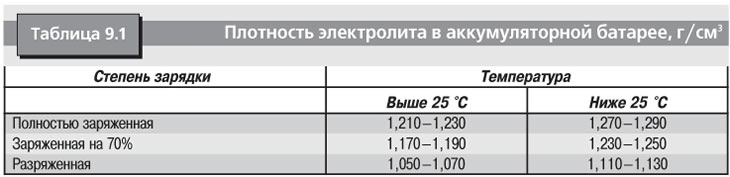
After determining the density of the electrolyte in each cell of the battery, establish the degree of its discharge according to the table. 9.1.
Measure the density of the electrolyte in each jar. A difference in density of 0.04 g/cm³ or more between any two cells indicates electrolyte loss or plate sulfation.
If the electrolyte density between any two cells differs by more than 0.04 g/cm³, replace the battery. If the electrolyte density is lower than required, but the same in all cells, charge the battery.
The performance of a maintenance-free battery can only be checked with a voltmeter. The charge level of a battery with a built-in indicator is determined by the color of the indicator. The green color of the indicator corresponds to a full charge, black indicates the need for charging, and blue indicates a low electrolyte level in the battery.
[You can find the original on the page PeugeotBook]