
English Русский
Български
Беларускі
Український
Српски
Hrvatski
Română
Polski
Slovenský
Magyar
Bookmark Articles Sitemap Contacts
Company Hyundai Company Opel Company Skoda Company Kia Company Mitsubishi Company LADA Company Audi
PeugeotBook.ru


Series 100   Series 200   Series 300   400-500   Series 600   Crossovers   Others
 
Peugeot 106 (1991-2003)

Cylinder head — dismantling (Peugeot 106)

  • Main
  • 10X
  • Peugeot 106 (1991-2003)
  • Power unit
  • Engine overhaul
  • Cylinder head — dismantling
0
Note: New and reconditioned cylinder heads are available from the manufacturer, and from engine overhaul specialists. Be aware that some specialist tools are required for the dismantling and inspection procedures, and new components may not be readily available. It may therefore be more practical and economical for the home mechanic to purchase a reconditioned head, rather than to dismantle, inspect and recondition the original head.


1. Remove the cylinder head as described in Part A or B of this Chapter (as applicable).

2. If not already done, remove the inlet and exhaust manifolds with reference to the relevant Part of Chapter 4.

3. Remove the camshaft (and followers on diesel engines and 16-valve petrol engines) as described in Part A or B of this Chapter.

4. Using a valve spring compressor, compress each valve spring in turn until the split collets can be removed. Release the compressor, and lift off the spring retainer, spring and spring seat (see illustration).
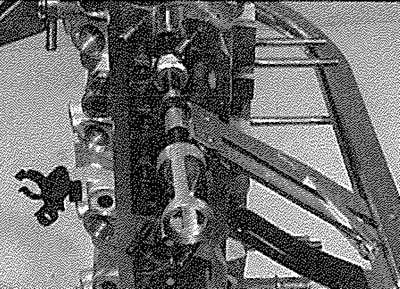
6.4. Using a valve spring compressor to compress the valve spring

6.4. Using a valve spring compressor to compress the valve spring


5. Using a pair of pliers, carefully extract the valve stem seal from the top of the guide (see illustration).
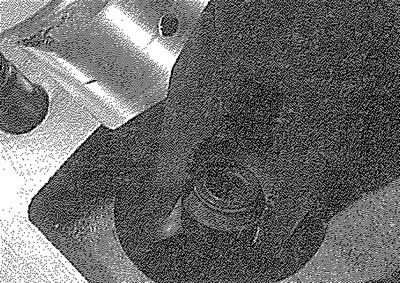


6.5. Remove the valve stem oil seal using a pair of pliers

6.5. Remove the valve stem oil seal using a pair of pliers


6. Withdraw the valve through the combustion chamber.

7. It is essential that each valve is stored together with its collets, retainer, spring, and spring seat (see illustration). The valves should also be kept in their correct sequence, unless they are so badly worn that they are to be renewed. If they are going to be kept and used again, place each valve assembly in a labelled polythene bag or similar small container. Note that No 1 valve is nearest to the transmission (flywheel) end of the engine.
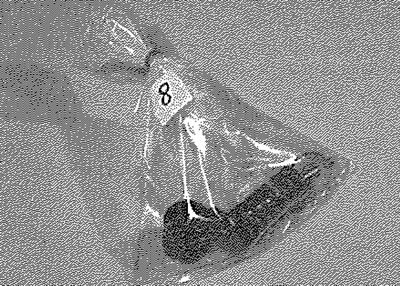
6.7. Place each valve and its associated components in a labelled polythene bag

6.7. Place each valve and its associated components in a labelled polythene bag
This article is available at russian, bulgarian, belarusian, ukrainian, serbian, croatian, romanian, polish, slovak, hungarian
Article reviewed by editor: Matveev Demid
Share information:
Previous
Peugeot 106: Engine overhaul
Next

Engine overhaul — dismantling sequence
Engine and transmission — removal, separation and refitting
Engine removal — methods and precautions
Engine overhaul — general information
General information
Cylinder head and valves — cleaning and inspection
Cylinder head — reassembly
Piston/connecting rod assembly — removal
Crankshaft — removal
Cylinder block/crankcase — cleaning and inspection
See similar information for other Peugeot models

➨ Cylinder head (petrol engines 1.4 and 1.6 l, EPZ, TU5) Peugeot 207 (2006-2014)
➨ Cylinder head — removal from the engine while it is on the… Peugeot 305 (1977-1989)
➨ Removal the cylinder head Peugeot 405 (1987-1997)
➨ Cylinder head — removal Peugeot 605 (1989-2000)
➨ Cylinder head — removal and installation Peugeot 806 (1994-2002)
Link to this article in different formats
Comments and feedback from visitors
No comments yet


Add two numbers 25 + 34


Peugeot 106 (1991-2003) 
  • General information
  • Introduction to manual
  • Weekly checks
  • Maintenance (petrol)
  • Maintenance (diesel)
  • Troubleshooting
  • Power unit
  • Petrol engines
  • Diesel engines
  • Engine overhaul
  • Cooling and heating
  • Fuel system (carburetor)
  • Single point injection (petrol)
  • Multipoint injection (petrol)
  • Fuel system (diesel)
  • Emission control system
  • Engine electrical equipment
  • Ignition system
  • Diesel heating
  • Transmission
  • Clutch
  • Manual gearbox
  • Automatic gearbox
  • Drive shafts
  • Chassis, running gear
  • Brake system
  • Car suspension
  • Steering
  • Body and interior
  • Exterior (external elements)
  • Interior (internal elements)
  • Doors, locks and windows
  • Electrical equipment
  • Equipment and devices
  • Electrical diagrams
PeugeotBook.ru © 2018–2026 | Mobile version | Sitemap: EN BG BY UA RS HR RO PL SK HU | Write message | Site search | Add to bookmarks | Peugeot owners
106 (1991-2003) | 206 (1998-2012) | 207 (2006-2014) | 305 (1977-1989) | 306 (1993-2002) | 307 (2001-2008) | 405 (1987-1997) | 406 (1995-2004) | 605 (1989-2000) | Partner-I (1996-2008) | Eurovans-807 (2002-2014) | Eurovans-806 (1994-2002) | J5 (1981-1993) |
Cookies are used to ensure the correct display of pages on the site.