
English Русский
Български
Беларускі
Український
Српски
Hrvatski
Română
Polski
Slovenský
Magyar
Bookmark Articles Sitemap Contacts
Company Hyundai Company Opel Company Skoda Company Kia Company Mitsubishi Company LADA Company Audi
PeugeotBook.ru


Series 100   Series 200   Series 300   400-500   Series 600   Crossovers   Others
 
Peugeot 305 (1977-1989) Peugeot 306 (1993-2002) Peugeot 307 (2001-2008)

Spark plugs (Peugeot 306)

  • Main
  • 30X
  • Peugeot 306 (1993-2002)
  • Gasoline engine
  • Ignition system
  • Spark plugs
0
Table of contents: Flawless appearance 🠇 Carbon deposits on spark plugs 🠇 Oiling the candle 🠇 Overheating of spark plugs 🠇
The manufacturer recommends types of spark plugs, but very often these recommendations change during production. It is therefore recommended to follow the latest recommendations when replacing spark plugs, that is, when purchasing new spark plugs, always indicate the engine type and year of manufacture. There are "cold" and "hot" spark plugs. It's best to consult a specialist before replacing them.

The interelectrode distance of the spark plugs is 0.7 - 0.8 mm and is measured in the manner shown in Figure 175.
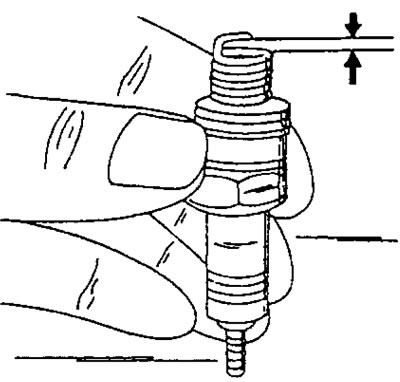
Figure 175. The interelectrode distance is measured between arrows «A».

Figure 175. The interelectrode distance is measured between arrows "A".


When checking spark plugs, the required value of the interelectrode distance is set. In no case should you bend the central electrode, as this may cause the porcelain insulator to crack. To maintain engine power, spark plugs are replaced every 20,000 km.

Before removing the spark plugs, check that there are no foreign objects in the recesses of the receiving holes. A washer, screw, stone, etc., falling into the hole when unscrewing the spark plug can damage the valves, valve seats or cylinder head the first time the engine is started.


Based on the appearance of the spark plug, one can draw conclusions about its suitability and normal operation, the composition of the mixture, the normal operation of the fuel injection system and the condition of the engine (pistons, piston rings, etc.). The general rules in this case are:

Flawless appearance


The base of the insulator is covered with a thin, yellow-gray to brown, often powdery coating. On the electrodes, in addition to the burnt surfaces, there is a yellow-gray to brown powdery coating. The inside of the body has a light brown or yellowish to blackish-brown coating. The engine is normal. The glow plug heat range is selected correctly.

Carbon deposits on spark plugs


The base of the insulator, the electrodes and the inside of the housing are covered with a thick, powdery, black-grey, resinous coating. The reason for this is a rich mixture, insufficient air supply, increased interelectrode distance, spark plugs have an increased heat rating and remain cold during operation. To eliminate this, install a spark plug with a different heat rating.

Oiling the candle


The base of the insulator, the electrodes and the inside of the housing are covered with a greasy, oil-slick coating. Formation of oil deposits. The cause may be oil penetration into the combustion chambers or wear of the cylinders and pistons.

Overheating of spark plugs


The base of the insulator is covered with a dark brown to grey-black, glassy or coarse, freshly baked coating, often with strong growths at the base of the insulator. The electrodes, especially the central electrode, are damaged. The surface is often rough, swollen, and corroded. The cause could be a lean mixture, poorly closing valves, or a spark plug with a low heat rating, which causes it to overheat. The deposits between the porcelain insulator and the spark plug body are removed by sandblasting. When screwing in a spark plug, be sure to thoroughly clean the threaded part first. Since the average spark plug lifespan is 20,000 km, cleaning every 10,000 km is sufficient. When installing the spark plug, do not overtighten it, as this will damage the sealing washer. The spark plug tightening torque value is from 18 to 28 Nm.
This article is available at russian, bulgarian, belarusian, ukrainian, serbian, croatian, romanian, polish, slovak, hungarian
Article reviewed by editor: Shirokov Arseny
Share information:
Previous
Peugeot 306: Ignition system
Next

General information about the ignition system
Ignition timing
See similar information for other Peugeot models

➨ Spark plug renewal Peugeot 106 (1991-2003)
➨ Spark plugs Peugeot 207 (2006-2014)
➨ Replacement of spark plugs (20,000 km/12 months) Peugeot 405 (1987-1997)
➨ Spark plugs — general information Peugeot 605 (1989-2000)
➨ Spark plugs Peugeot 806 (1994-2002)
Link to this article in different formats
Comments and feedback from visitors
No comments yet


Add two numbers 29 + 11


Peugeot 307 (2001-2008) 
  • User manual
  • Keys, doors and alarm
  • Controls and instruments
  • Driving and operation
  • Maintenance
  • Power unit
  • Petrol engines TU3 and TU5
  • Petrol engines EW10
  • Diesel engines DV10
  • Diesel engines DW10
  • Transmission
  • Clutch and drive shafts
  • Mechanical gearbox
  • Automatic gearbox
  • Chassis, running gear
  • Front suspension
  • Rear suspension
  • Steering
  • Brake system
  • Body and interior
  • Exterior (external elements)
  • Interior (internal elements)
  • Doors, locks and windows
  • Heating and air conditioning
  • Electrical equipment
  • Equipment and devices
  • Power devices
  • Airbags
  • Electrical circuits
Peugeot 306 (1993-2002) 
  • General information
  • Introduction to manual
  • Specifications
  • Gasoline engine
  • Engine repair
  • Lubrication system
  • Cooling system
  • Fuel injection
  • Ignition system
  • Diesel engine
  • Engine repair
  • Lubrication system
  • Cooling system
  • Fuel injection
  • Transmission
  • Clutch
  • Gearbox
  • Drive shafts
  • Chassis, running gear
  • Steering system
  • Front suspension
  • Rear suspension
  • Brake system
  • Electrical equipment
  • Power devices
  • Electrical circuits
Peugeot 305 (1977-1989) 
  • General information
  • Maintenance
  • Power unit
  • Gasoline engines
  • Diesel engines
  • Cooling system (gasoline)
  • Cooling system (diesel)
  • Fuel system (gasoline)
  • Fuel system (diesel)
  • Ignition system
  • Transmission
  • Clutch
  • Mechanical gearbox BB8
  • Mechanical gearbox BE1
  • Automatic gearbox ZF4
  • Shafts, hubs and wheels
  • Chassis, running gear
  • Brake system
  • Car suspension
  • Steering
  • Body and interior
  • Exterior (external elements)
  • Interior (internal elements)
  • Electrical equipment
  • Equipment and devices
  • Headlights and lighting
  • Power devices
  • Electrical circuits
  • Wiring diagrams (diesel)
PeugeotBook.ru © 2018–2026 | Mobile version | Sitemap: EN BG BY UA RS HR RO PL SK HU | Write message | Site search | Add to bookmarks | Peugeot owners
106 (1991-2003) | 206 (1998-2012) | 207 (2006-2014) | 305 (1977-1989) | 306 (1993-2002) | 307 (2001-2008) | 405 (1987-1997) | 406 (1995-2004) | 605 (1989-2000) | Partner-I (1996-2008) | Eurovans-807 (2002-2014) | Eurovans-806 (1994-2002) | J5 (1981-1993) |
Cookies are used to ensure the correct display of pages on the site.