



Collapse — this is the angle between the plane of rotation and the vertical of the wheel. It can be positive if the wheels are tilted outward, or negative if the wheels are tilted inward. The camber angle mainly affects the uniformity of wear on the front tires. If the camber angle of one wheel is positive and the other is negative, the car will pull to the side when driving straight.
Convergence — the difference in the distances between the side flanges of the rims, measured behind and in front of the wheels at the level of their centers. Positive toe-in means that the front wheels are positioned closer together than the rear wheels, at their center lines. Negative toe means that the front wheels are further apart than the rear wheels.
Lateral inclination of the wheel steering axis — is the angle between the axis of inclination of the steering knuckle and the vertical drawn through the wheel attachment point in the longitudinal plane of the car.
Due to the camber angles and the lateral tilt of the steering axis, the points of contact of the wheels with the road are located closer to the axis of the steering knuckle. This maintains the so-called "running-in shoulder." The shorter the "running-in shoulder," the easier the car is to control. In addition, impacts from uneven surfaces are less transmitted to the steering wheel.
Angle of longitudinal inclination of the axis of rotation — is the angle between the axis of inclination of the steering knuckle and the vertical drawn through the wheel mounting point, in a plane perpendicular to the longitudinal axis of the vehicle. The axis around which the wheel rotates is positioned in space so that its lower part is tilted forward. This angle of longitudinal inclination is called positive. A positive angle value ensures better stability and stabilization of the steered wheels when driving in a straight line.
Checking and adjusting wheel alignment angles must be carried out at a service station due to the complexity of the equipment used.
Front wheel alignment adjustment:
Note: Only wheel alignment is adjustable on the front suspension.
[Original can be viewed at PeugeotBook]
- set the front wheels to straight ahead;
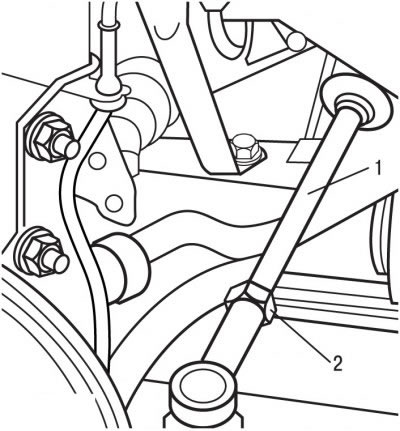
Figure 7.35. Adjusting the front wheel alignment: 1 - steering rod; 2 - steering rod end
- loosen locknut 2 (figure 7.35) tie rod end fasteners;
- by rotating the steering rod 1, adjust the toe-in and tighten the lock nut 2 to a torque of 40 N·m.
Note: One turn of the steering rod changes the toe-in value by approximately 2 mm.