



The "economy" mode is the standard mode, it is activated when driving at low speeds, it provides economical driving. When driving in the "sport" mode, the upshifts are engaged at a higher engine speed than in the normal mode. In the "winter" mode, when the car starts moving, the 2nd gear is automatically engaged, which provides the necessary traction of the wheels on a slippery road and reduces their tendency to slip.
Technical data and characteristics
| Type | automatic, four-speed, electronically controlled |
| Volume of working fluid to be filled liquids, l: | |
| after draining the working fluid | 4 |
| after removal and installation of the hydraulic unit housing | 1,5 |
| after draining the fluid and replacing the hydraulic unit | 4,5 |
| after draining the fluid and replacing the torque converter | 5 |
| Brand of the working fluid being filled | ESSO LT 71141 |
The gearbox is controlled by the selector lever. The engine is started only when the selector lever is in the "P" or "N" position.
When the lever is in position "D", four gears are automatically shifted from low to high and vice versa (depending on engine load, driving conditions and speed).
In position "3" 1st, 2nd or 3rd gear is automatically shifted up and down depending on engine load and driving speed; 4th gear is not engaged.
In position "2" 1st or 2nd gear is automatically shifted up and down depending on the engine load and driving speed, 3rd and 4th gears are not engaged.
In position "1" the car moves only in 1st gear, 2nd, 3rd and 4th gears are not engaged. This achieves the maximum possible engine braking efficiency.
When operating a car with an automatic transmission, you need to know that the gearbox is lubricated only when the engine is running. Therefore, if you have to tow the car, you must do so with the drive wheels raised. It is prohibited to move with the ignition off. It is also prohibited to push the car to start the engine.
When operating the vehicle, the following requirements must be met:
- the battery must not be disconnected when the engine is running;
- when the ignition is on, you cannot disconnect the computer;
- before connecting any connector, check the condition of all connectors and terminals;
- check the condition of the mechanical lock;
- when checking electrical equipment, the battery must be charged;
- it is prohibited to use a power source with a voltage higher than 16 V;
- it is prohibited to use the test lamp.
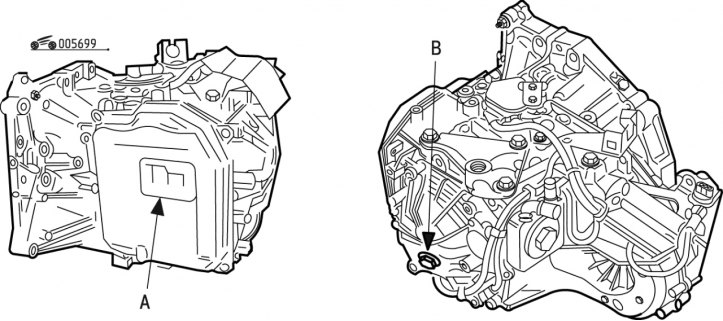
Figure 6.99. Automatic transmission markings: A, B - marking locations
The gearbox marking is applied on a self-adhesive plate in zone A (figure 6.99) or engraving in zone B
Possible places of leakage of working fluid in automatic transmission and methods of elimination
The source is located on the website [www.peugeotbook.ru]
| Leak locations | Method of elimination |
| Gear shift shaft under the multi-function switch | Replace the sealing ring |
| Filler cap | Replace the plug seal |
| Seal at the differential outlet | Replace the seal |
| Speedometer drive gear | Replace the sealing ring |
| Heat exchanger | Check the tightness of the hollow bolt. |
| Check the heat exchanger gasket | |
| Solenoid valve | Replace the sealing ring |
| Between the main crankcase and the rear cover | Replace the gearbox |
| Plug with hole for hydraulic unit wiring harness | Replace the sealing ring |
| Hydraulic block housing | Check the tightness of the hydraulic unit. |
| Check the crankcase gasket | |
| Sector axis with balls | Replace the sealing ring |
| Between the main housing and the torque converter housing | Replace the gearbox |
| Speed sensor | Replace the sealing ring |
| Plug for determining the level of working fluid | Replace the sealing gasket |
| Pressure sensor in the circuit | Replace the sealing ring |