



Removal
Disconnect the battery.
Remove the protection under the engine (if necessary).
Protect the cooling system radiator fins from damage. Unscrew the bolt and remove the turbocharger resonance damper. Remove the engine cooling system pipes, hoses and radiator (see the corresponding operation).
Remove the oxygen sensors (vehicles with particulate filter, see relevant operation). Disconnect the exhaust gas temperature sensor.
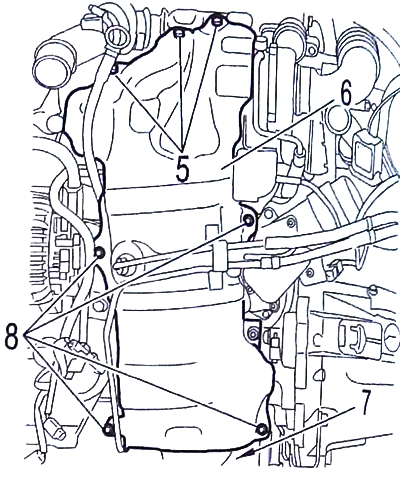
Remove three bolts (5), four bolts (8) and remove the heat shield (6).
Remove the upper heat shield (two bolts) and clamp (7). Disconnect the catalytic converter (10) from the turbocharger.
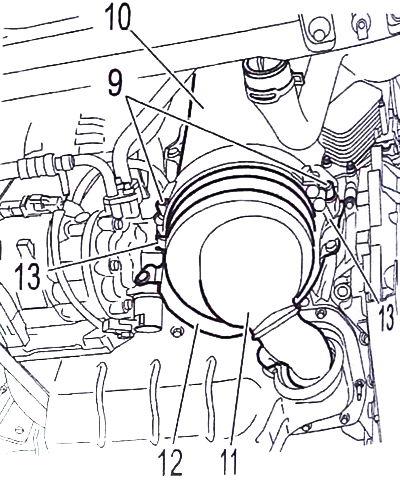
Unscrew the nuts (9) and remove the neutralizer block (10) and mechanical filter (11).
Remove the heat shield (12) and clamp (13).
Disconnect tubes (14) and (17).
Move the oil pipe (14).
Unscrew the four nuts (15) and the nut (16).
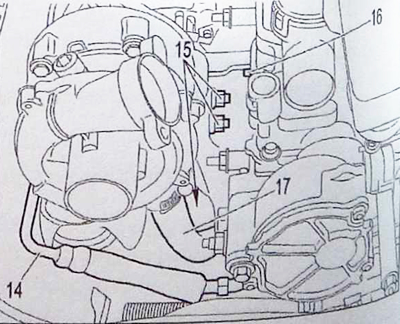
Disconnect the exhaust manifold from the turbocharger.
Remove the turbocharger.
Installation
Wipe down the air cleaner system.
Make sure the lubrication system connections are clean.
Install new seals.
Use only recommended mounting screws (resistance to heating).
Make sure there are no foreign objects in the intake system and exhaust manifold (risk of destruction of the turbocharger when it is turned on).
Place the turbocharger in place in the engine compartment and connect it to the exhaust manifold.
Install the nuts (15) and tighten to a torque of 25±5 Nm.
Install the oil pipe (14) in place.
Note: Ensure the distance of the oil pipe from the two turbine housings using an 8mm feeler gauge.
Connect the grease tube (14) (tighten to 30±5 Nm) and the tube (17).
Install the remaining parts in reverse order.
Connect the battery.
Before the vehicle starts moving
Disconnect the engine speed sensor connector.
Crank the engine with the starter until the oil pressure indicator goes out.
Connect the engine speed sensor connector.
Let the engine run for 30 seconds before increasing the load.
After starting the engine, check the tightness of all pipe connections.