
English Русский
Български
Беларускі
Український
Српски
Hrvatski
Română
Polski
Slovenský
Magyar
Bookmark Articles Sitemap Contacts
Company Hyundai Company Opel Company Skoda Company Kia Company Mitsubishi Company LADA Company Audi
PeugeotBook.ru


Series 100   Series 200   Series 300   400-500   Series 600   Crossovers   Others
 
Peugeot 305 (1977-1989) Peugeot 306 (1993-2002) Peugeot 307 (2001-2008)

Engine and gearbox — removal (Peugeot 305)

  • Main
  • 30X
  • Peugeot 305 (1977-1989)
  • Power unit
  • Gasoline engines
  • Engine and gearbox — removal
0
1. The engine and gearbox can only be removed as a single unit and not separately. The overall weight of the engine and gearbox is not that great due to the extensive use of aluminum alloy, however, some operations are associated with certain difficulties, and care must be taken not to damage the parts remaining in the engine compartment, as the space for maneuvering is limited (especially when removing the engine from the gearbox). Therefore, whenever possible, try to work with an assistant.

2. To disconnect the drive shafts from the final drive, the manufacturer recommends disassembling the right front suspension so that the front strut can be moved to the side and the right drive shaft can be pulled out. However, we found that with the engine hanging freely on the hoists, the drive shafts could be disconnected without affecting the front suspension. This was done on the SR model and is possible (although it is doubtful), that on other models the front suspension will still have to be disassembled. In any case, you should first try to do it without disassembling the suspension. If this doesn't work, you'll have to disassemble the right front suspension (see chapter 9) and then disconnect the right drive shaft.

3. Position the car so that the engine is directly under the lift, and check that there is enough space to roll the car back after lifting the engine and gearbox.

4. Block the rear wheels and apply the handbrake.

5. Lift and support the hood. Mark the position of the hood hinge brackets on the hood so that they can be installed exactly in their original position later. Unscrew the bracket mounting bolts and support the rack. Remove the hood lid.


6. Disconnect the wires from the battery and remove it (see chapter 10).

7. Drain the liquid from the cooling system (see chapter 2). Drain the oil from the engine and replace the oil pan plug.

8. Remove the radiator (see chapter 2).

9. Remove the air cleaner and air intake (see chapter 3).

10. Disconnect the hoses from the engine (for example, the brake booster on the manifold, heater hoses, etc.). After disconnecting the fuel supply hose, temporarily plug its end to prevent coolant leakage.

11. Disconnect the spark plug wires from the spark plugs, remove the distributor cap and remove it from the engine along with the wires.

12. Disconnect the wiring from the following parts (having previously memorized the position):
  • a. Coolant temperature sensor.
  • b. Oil pressure relay.
  • c. Ignition coil.
  • radiator temperature sensor (fan thermal switch).
  • d. Starter solenoid.
  • e. Ground wire - from the top of the timing case.
  • f. Reverse light switch.

There is no need to disconnect the wires from the generator. Instead, remove the generator (see chapter 10) and turn it away from the engine. Similarly, when disconnecting the wires from the voltage regulator, unscrew the bolts securing it to the inner wall on the left front fender arch and turn the regulator away from the engine compartment so that it does not interfere.

14. Disconnect the throttle and choke cables from the carburetor.

15. Disconnect the exhaust pipe from the manifold at the front of the engine.

16. Disconnect the gear shift lever mechanism. The work will be easier if you first remove the intake manifold support stand. Disconnect the ball joint cup at the end of the gear shift rod and the ball joint cup on the shift shackle, and then unscrew the bolt securing the ball joint of the gear shift rod to the gear shift mechanism cover (see figure 1.3).
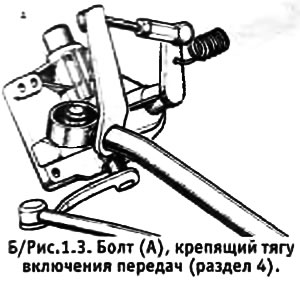


16. Disconnect the gear shift lever mechanism. The work will be easier if you first remove the…


17. Jack up the front of the car and support it with supports under the front subframe (alternatively, you can install repair ramps under the front wheels).

18. Remove the front section of the exhaust pipe from the engine.

19. Disconnect the clutch cable (see chapter 5).

20. Remove three bolts from the lower engine mount (two are on the front surface and one is at the rear) (see photo).
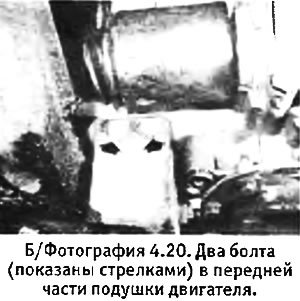
20. Remove three bolts from the lower engine mount (two are on the front surface and one is at the…


21. Connect the hoists to the two ears at the rear of the cylinder head and lift the engine with a hoist just enough to remove it from the mounts.

22. Disconnect the upper engine mounts and remove the engine support brackets so that they do not interfere.
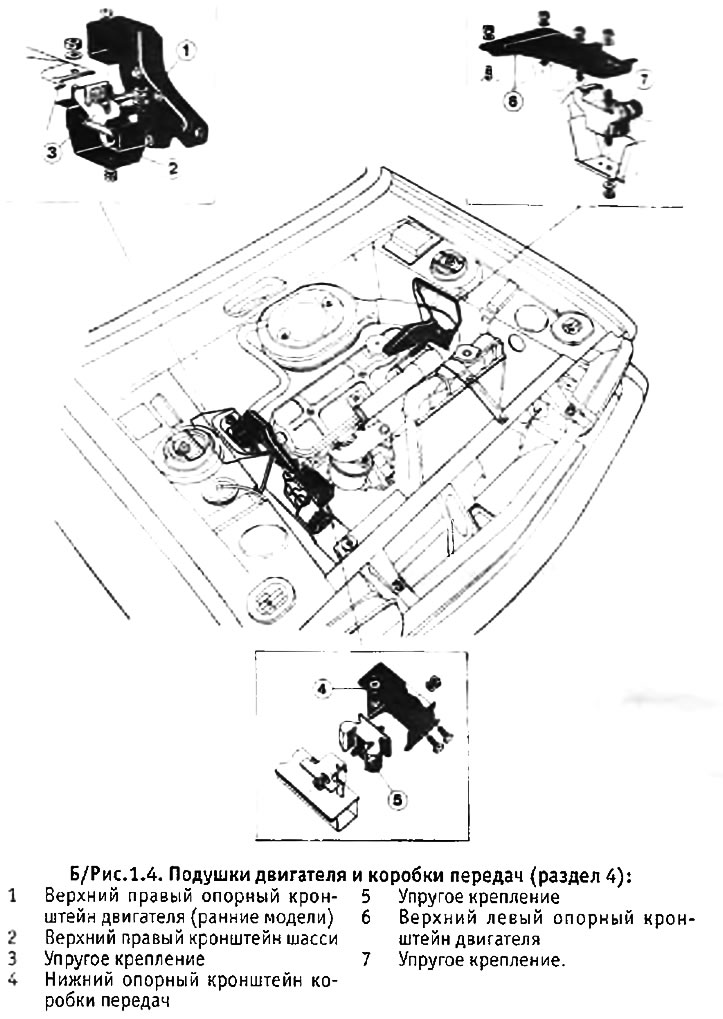
22. Disconnect the upper engine mounts and remove the engine support brackets so that they do not…


23. Raise the engine so that it is clear of the lower mount and at the same time pull it forward so that the rear end of the gearbox housing is clear of the steering gear.


24. Loosen the lock nut, remove the screw and pull the speedometer drive cable out of the gearbox.

25. Check that everything is disconnected from the engine and gearbox.

26. Turn one of the front wheels to the side until it stops so that its drive shaft can be pulled out. Carefully lift the engine and move it away from this wheel to disconnect the drive shaft. Disconnect the second drive shaft in the same manner. Support both shafts on the subframe and carefully lift the engine and gearbox out of the engine compartment. If necessary, roll the car back so that the engine and gearbox can be lowered to the ground.
This article is available at russian, bulgarian, belarusian, ukrainian, serbian, croatian, romanian, polish, slovak, hungarian
Article reviewed by editor: Ostrovsky Fedor
Share information:
Previous
Peugeot 305: Gasoline engines
Next

Basic operations requiring removal of the engine from the vehicle
Basic operations that can be carried out without removing the…
XU Series Engine — general description
Timing Housing Seal (all models)
Side main cover bolts (XR5S engine)
Engine disassembly — general part
Engine Disassembly — auxiliary equipment
Removal with gearbox (XU series engine)
Disconnecting the gearbox from the XU series engine
Disassembling the XU series engine
See similar information for other Peugeot models

➨ Engine oil and filter renewal Peugeot 106 (1991-2003)
➨ Starting the engine with an additional battery Peugeot 207 (2006-2014)
➨ Removal and installation of engine and gearbox Peugeot 406 (1995-2004)
➨ Starting the engine Peugeot 605 (1989-2000)
➨ Engine/Gearbox Mounts — inspection and replacement Peugeot Partner I (1996-2008)
Link to this article in different formats
Comments and feedback from visitors
No comments yet


Add two numbers 24 + 23


Peugeot 307 (2001-2008) 
  • User manual
  • Keys, doors and alarm
  • Controls and instruments
  • Driving and operation
  • Maintenance
  • Power unit
  • Petrol engines TU3 and TU5
  • Petrol engines EW10
  • Diesel engines DV10
  • Diesel engines DW10
  • Transmission
  • Clutch and drive shafts
  • Mechanical gearbox
  • Automatic gearbox
  • Chassis, running gear
  • Front suspension
  • Rear suspension
  • Steering
  • Brake system
  • Body and interior
  • Exterior (external elements)
  • Interior (internal elements)
  • Doors, locks and windows
  • Heating and air conditioning
  • Electrical equipment
  • Equipment and devices
  • Power devices
  • Airbags
  • Electrical circuits
Peugeot 306 (1993-2002) 
  • General information
  • Introduction to manual
  • Specifications
  • Gasoline engine
  • Engine repair
  • Lubrication system
  • Cooling system
  • Fuel injection
  • Ignition system
  • Diesel engine
  • Engine repair
  • Lubrication system
  • Cooling system
  • Fuel injection
  • Transmission
  • Clutch
  • Gearbox
  • Drive shafts
  • Chassis, running gear
  • Steering system
  • Front suspension
  • Rear suspension
  • Brake system
  • Electrical equipment
  • Power devices
  • Electrical circuits
Peugeot 305 (1977-1989) 
  • General information
  • Maintenance
  • Power unit
  • Gasoline engines
  • Diesel engines
  • Cooling system (gasoline)
  • Cooling system (diesel)
  • Fuel system (gasoline)
  • Fuel system (diesel)
  • Ignition system
  • Transmission
  • Clutch
  • Mechanical gearbox BB8
  • Mechanical gearbox BE1
  • Automatic gearbox ZF4
  • Shafts, hubs and wheels
  • Chassis, running gear
  • Brake system
  • Car suspension
  • Steering
  • Body and interior
  • Exterior (external elements)
  • Interior (internal elements)
  • Electrical equipment
  • Equipment and devices
  • Headlights and lighting
  • Power devices
  • Electrical circuits
  • Wiring diagrams (diesel)
PeugeotBook.ru © 2018–2026 | Mobile version | Sitemap: EN BG BY UA RS HR RO PL SK HU | Write message | Site search | Add to bookmarks | Peugeot owners
106 (1991-2003) | 206 (1998-2012) | 207 (2006-2014) | 305 (1977-1989) | 306 (1993-2002) | 307 (2001-2008) | 405 (1987-1997) | 406 (1995-2004) | 605 (1989-2000) | Partner-I (1996-2008) | Eurovans-807 (2002-2014) | Eurovans-806 (1994-2002) | J5 (1981-1993) |
Cookies are used to ensure the correct display of pages on the site.