
English Русский
Български
Беларускі
Український
Српски
Hrvatski
Română
Polski
Slovenský
Magyar
Bookmark Articles Sitemap Contacts
Company Hyundai Company Opel Company Skoda Company Kia Company Mitsubishi Company LADA Company Audi
PeugeotBook.ru


Series 100   Series 200   Series 300   400-500   Series 600   Crossovers   Others
 
Peugeot 305 (1977-1989) Peugeot 306 (1993-2002) Peugeot 307 (2001-2008)

General information and design of the front suspension (Peugeot 307)

  • Main
  • 30X
  • Peugeot 307 (2001-2008)
  • Chassis, running gear
  • Front suspension
  • General information and design of the front suspension
0
The suspension is the link between the body and the wheels. Through it, the forces acting on the wheels are transmitted to the body. The suspension serves to reduce dynamic loads, reduce body vibrations, soften the impact of wheels on uneven roads, and ensures stability and a smooth ride of the vehicle. The suspension geometry and its rigidity determine the body's ability to move and the reduction of angular vibrations around the vehicle's longitudinal and transverse axes.

The front suspension is an independent McPherson strut. It is characterized by its compact size, low weight, and higher mounting height, while the increased distance between the bearings reduces structural stress in the suspension components. One of the main advantages of the suspension is its relative insensitivity to installation tolerances.

The lower arms are connected on one side to the steering knuckles via ball joints, and on the other side to the subframe via silent blocks. The caliper and brake disc with hub are attached to the steering knuckle.
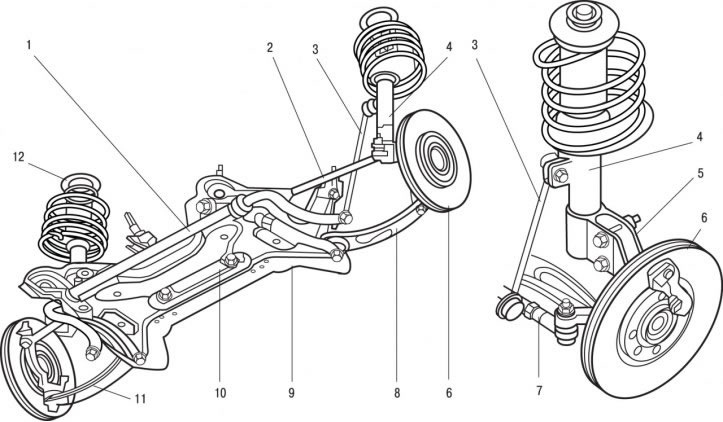
Figure 6.1. Elements of the front suspension design: 1 - anti-roll bar; 2 - steering rod; 3 -…

Figure 6.1. Elements of the front suspension design: 1 - anti-roll bar; 2 - steering rod; 3 - stabilizer rod; 4 - left shock absorber strut; 5 - steering knuckle; 6 - brake disc; 7 - steering rod end; 8 - left lower wishbone; 9 - sub-engine frame; 10 - steering gear; 11 - right lower wishbone; 12 - right shock absorber strut


Figure 6.1 shows the elements of the front suspension design.

Caution! Welding and straightening work on front suspension components is strictly prohibited. Be sure to replace self-locking nuts, as well as bolts with signs of corrosion.


(Information copied from the resource: PEUGEOTBOOK)
This article is available at russian, bulgarian, belarusian, ukrainian, serbian, croatian, romanian, polish, slovak, hungarian
Article reviewed by editor: Sidorov Timofey
Share information:
Previous
Peugeot 307: Front suspension
Next

 
Front suspension specifications
Replacing the shock absorber strut
Disassembly and assembly of the shock absorber strut
Replacing the steering knuckle
Replacing the front wheel hub bearing
See similar information for other Peugeot models

➨ Front suspension strut — removal, overhaul and refitting Peugeot 106 (1991-2003)
➨ General characteristics and tightening torques of the front… Peugeot 207 (2006-2014)
➨ Front suspension — design description Peugeot 405 (1987-1997)
➨ Front suspension — general information Peugeot 605 (1989-2000)
➨ Front suspension Peugeot 806 (1994-2002)
Link to this article in different formats
Comments and feedback from visitors
No comments yet


Add two numbers 44 + 41


Peugeot 307 (2001-2008) 
  • User manual
  • Keys, doors and alarm
  • Controls and instruments
  • Driving and operation
  • Maintenance
  • Power unit
  • Petrol engines TU3 and TU5
  • Petrol engines EW10
  • Diesel engines DV10
  • Diesel engines DW10
  • Transmission
  • Clutch and drive shafts
  • Mechanical gearbox
  • Automatic gearbox
  • Chassis, running gear
  • Front suspension
  • Rear suspension
  • Steering
  • Brake system
  • Body and interior
  • Exterior (external elements)
  • Interior (internal elements)
  • Doors, locks and windows
  • Heating and air conditioning
  • Electrical equipment
  • Equipment and devices
  • Power devices
  • Airbags
  • Electrical circuits
Peugeot 306 (1993-2002) 
  • General information
  • Introduction to manual
  • Specifications
  • Gasoline engine
  • Engine repair
  • Lubrication system
  • Cooling system
  • Fuel injection
  • Ignition system
  • Diesel engine
  • Engine repair
  • Lubrication system
  • Cooling system
  • Fuel injection
  • Transmission
  • Clutch
  • Gearbox
  • Drive shafts
  • Chassis, running gear
  • Steering system
  • Front suspension
  • Rear suspension
  • Brake system
  • Electrical equipment
  • Power devices
  • Electrical circuits
Peugeot 305 (1977-1989) 
  • General information
  • Maintenance
  • Power unit
  • Gasoline engines
  • Diesel engines
  • Cooling system (gasoline)
  • Cooling system (diesel)
  • Fuel system (gasoline)
  • Fuel system (diesel)
  • Ignition system
  • Transmission
  • Clutch
  • Mechanical gearbox BB8
  • Mechanical gearbox BE1
  • Automatic gearbox ZF4
  • Shafts, hubs and wheels
  • Chassis, running gear
  • Brake system
  • Car suspension
  • Steering
  • Body and interior
  • Exterior (external elements)
  • Interior (internal elements)
  • Electrical equipment
  • Equipment and devices
  • Headlights and lighting
  • Power devices
  • Electrical circuits
  • Wiring diagrams (diesel)
PeugeotBook.ru © 2018–2026 | Mobile version | Sitemap: EN BG BY UA RS HR RO PL SK HU | Write message | Site search | Add to bookmarks | Peugeot owners
106 (1991-2003) | 206 (1998-2012) | 207 (2006-2014) | 305 (1977-1989) | 306 (1993-2002) | 307 (2001-2008) | 405 (1987-1997) | 406 (1995-2004) | 605 (1989-2000) | Partner-I (1996-2008) | Eurovans-807 (2002-2014) | Eurovans-806 (1994-2002) | J5 (1981-1993) |
Cookies are used to ensure the correct display of pages on the site.