



- remove the shock absorber strut from the car;
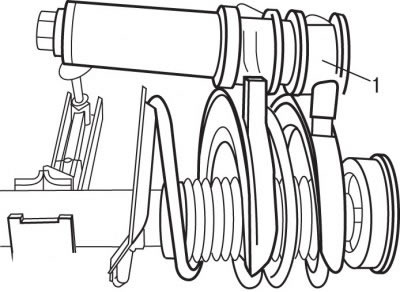
Figure 6.5. Compressing the shock absorber spring using the MG INTERNATIONAL tool (1)
- secure the front suspension shock absorber strut in a fixture secured in a vice and, using the special MG INTERNATIONAL or U77 FACOM tool, compress the spring so that it moves away from the top of the strut (figure 6.5). When using a special device for compressing springs, the spring coils must be securely grasped and the spring compressed from opposite sides;
Caution! The spring has a very high compression force, so use only a reliable tool. Do not tie the spring with wire under any circumstances.
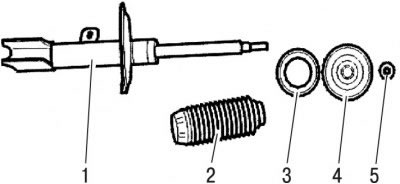
Figure 6.6. Shock absorber strut elements: 1 - shock absorber; 2 - protective cover; 3 - stop; 4 - upper spring support; 5 - nut, 69 Nm
- using a wrench to prevent the shock absorber rod from turning, and using another open-end wrench or a special TORX 45 wrench, unscrew the central nut securing the shock absorber rod (figure 6.6);
Caution! The central nut securing the shock absorber rod can only be unscrewed when the spring is compressed.
- remove the upper spring support 4, stop 3 and protective cover 2 from the shock absorber rod;
- release the device and check the condition of the spring, if there is any damage (cracks in the turns or their deformation) replace the spring.
Basic methods for checking the shock absorber:
1) characteristic signs indicating a faulty shock absorber are:
- prolonged rocking of the body when driving on uneven road surfaces;
- increasing body vibration when driving on uneven road surfaces;
- uneven and unstable movement of the wheels (bouncing) when driving in a certain speed range, including on turns;
- deviation from the intended trajectory of the vehicle's movement during braking;
- unstable cornering and skidding of the car;
- increased tire wear characterized by abrasion of the tire pattern;
- the appearance of clicks and extraneous noise when the vehicle is moving. Clicking and light knocking sounds can also be caused by other suspension faults, such as loose threaded connections, failure of wheel bearings, or wear of constant velocity joints on the drive shafts;
2) To check the technical condition of the shock absorber, remove it from the car;
3) inspect the shock absorber body and rod. There should be no mechanical damage on the body and no signs of corrosion on the rod. Place the shock absorber in a vertical position and test its operation by moving the shock absorber piston rod through its full stroke and up and down by 50-100 mm. In all cases, the piston rod should move smoothly with noticeable resistance. If the piston rod moves jerkily or is damaged, the shock absorber must be replaced;
4) the gas-filled shock absorber piston rod may spontaneously extend out of the shock absorber. The absence of spontaneous extension of the piston rod from the shock absorber does not indicate a malfunction of the shock absorber. In this case, the operating mode of the gas-filled shock absorber corresponds to the operating mode of the hydraulic shock absorber. The shock absorber performs its functions even without excess gas pressure, but additional noise may appear when the piston moves;
5) Check for shock absorber fluid leaks. A slight oil leak is permissible while maintaining normal operation of the shock absorber. If the spot of fluid leaking from the shock absorber extends only to the lower spring support, then this is considered a normal phenomenon. If there is a slight leak of fluid from the shock absorber, the shock absorber rod sealing ring is lubricated, which increases its service life;
6) If there are severe fluid leaks, replace the shock absorber.
Attention! When installing, it is necessary to use springs with the same technical characteristics on one axle of the vehicle (with the same color markings).
Assemble the shock absorber in the reverse order of removal, taking into account the following:
- while holding the shock absorber rod from turning, screw on a new shock absorber rod mounting nut and tighten it to a torque of 69 N·m;
- check that the upper coil of the spring is correctly positioned on the upper spring support;
- install the shock absorber strut on the car.