English Русский
Български
Беларускі
Український
Српски
Hrvatski
Română
Polski
Slovenský
Magyar
Bookmark Articles Sitemap Contacts
Company Hyundai Company Opel Company Skoda Company Kia Company Mitsubishi Company LADA Company Audi
PeugeotBook.ru


Series 100   Series 200   Series 300   400-500   Series 600   Crossovers   Others
 
Peugeot 305 (1977-1989) Peugeot 306 (1993-2002) Peugeot 307 (2001-2008)

Radios and car stereos — radio interference suppression (general part) (Peugeot 305)

  • Main
  • 30X
  • Peugeot 305 (1977-1989)
  • Electrical equipment
  • Equipment and devices
  • Radios and car stereos — radio interference suppression (general part)
0
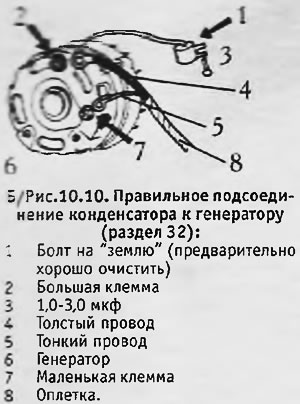
The main source of radio interference is a running generator. It produces a noise similar to that of an electric mixer, with the "mixer" working faster as the motor speed increases. To suppress generator interference, simply connect a 1.0-3.0 μF capacitor between ground and the large terminal of the generator, to which wires "1" and "4" are connected. Remember that connecting the capacitor to the small terminal of the generator will likely permanently damage it (see B/ Figure 10.10).

The main source of radio interference is a running generator. It produces a noise similar to that…


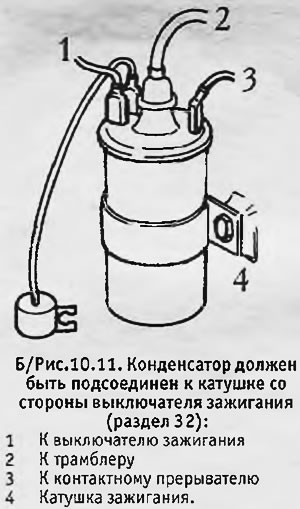
The second common source of radio interference is the ignition system. In this case, you should connect a 1.0 μF capacitor between the ground and the "SW" or "+" terminal of the ignition coil (see B/Figure 10.11). This will eliminate the ticking sound from the speakers.
The second common source of radio interference is the ignition system. In this case, you should…


Another source of interference is spark plugs. The Peugeot 305 uses special ignition wires with built-in radio interference suppression, but if they are replaced with regular ones, problems may arise.


To suppress radio interference from spark plugs, you can install special resistive caps on them (see B/Figure 10.12), whose resistance ranges from 10,000 to 15,000 ohms. If space is limited and resistive caps cannot be installed, linear radio interference suppressors can be used (see B/Figure 10.12) (if the noise is not too strong, it is enough to install one suppressor on the wire between the coil and the distributor. If this does not help, suppressors must be installed on all ignition wires).
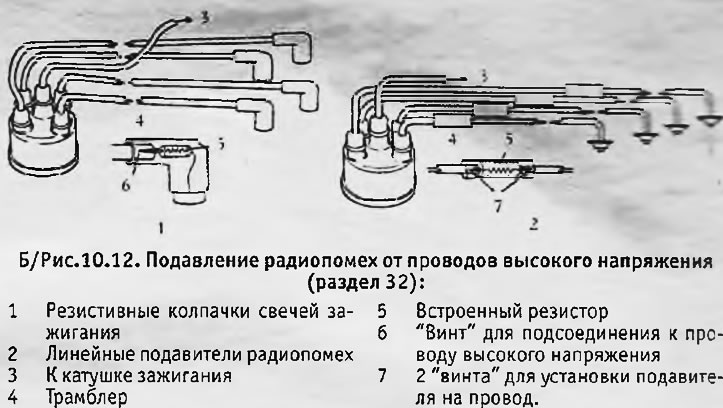
To suppress radio interference from spark plugs, you can install special resistive caps on them…


Check the grounding of the radio and antenna. If possible, keep the length of the radio receiver's power cable to a minimum.

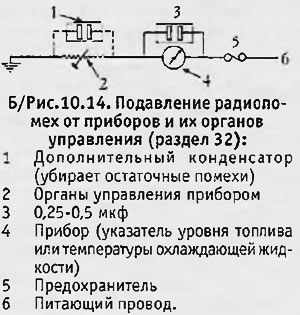
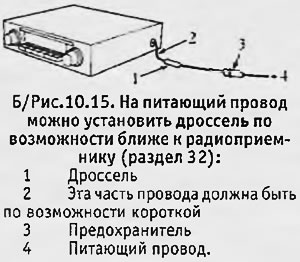
If all common sources of radio interference have been checked and "neutralized" and the noise persists, all electric motors, light switches, and appliances should be checked. The solution to the problem in this case is shown in Figure 10.13 (not very strong interference from the electric motor) and 10.14 (interference from operating devices). Interference from the light switch is generally not suppressed. Recently, when a radio receiver is factory-installed, a choke has been installed on its power supply line in addition to a fuse, which also helps suppress radio interference. If you do not have such a throttle, install it as shown in B/Figure 10.15.
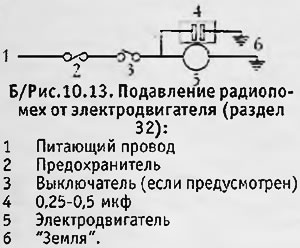


If all common sources of radio interference have been checked and «neutralized» and the noise…

If all common sources of radio interference have been checked and «neutralized» and the noise…


In the case of a transistor radio, a 2 A choke is sufficient. If you have an electric clock in your car, interference from it can be eliminated using a 0.5 μF capacitor installed as shown in Figure 10.13 for an electric motor.

If the interference does not disappear even after all the measures taken, check whether it is passing through the wires. You can try replacing the regular power cable with a shielded one.


In the worst case scenario, check whether interference is caused by interference from metal parts of the car rubbing against each other (if the fasteners are not tightened properly). Interference of this kind is removed by shunting the "noisy" connection with a wide ground bus with a braid. The most likely sources of interference may be the mounting locations:
  • a. muffler
  • b. exhaust pipes (at the point of contact with the cylinder block)
  • in. air purifier
  • front and rear bumpers
  • steering column
  • e. hood and trunk lids (their locks)

Interference of this kind is most noticeable (1) at idle, (2) under engine load.

A pulsating grinding noise when driving can be caused by static electricity building up on the wheels or tires. To remove them, it is necessary to "inject" a special antistatic powder into each tire.

Interference in the form of a shrill howling sound that changes its tone as the car moves and appears and disappears can be caused by the antenna (especially telescopic). To remove them, simply place a small rubber ball on the end of the antenna. If interference occurs during braking, it is caused by static electricity build-up in the brakes (especially noticeable in hot, dry weather). Such interference can only be removed by installing a special, very expensive brake kit.

(Data published on the website: PEUGEOTBOOK.ru)

Car radios are less susceptible to interference, but if it does occur, it's important to eliminate interference from the generator and ignition system and install a 3-5 A choke on the power supply wire. In the most severe cases, shielding the power supply wire and the wires leading to the speakers can be helpful.

Note: In case of electronic ignition system, it is not recommended to install resistive caps on spark plugs or a capacitor on the ignition coil. because this may result in damage to the system. Most electronic ignition systems have built-in radio interference suppressors.
This article is available at russian, bulgarian, belarusian, ukrainian, serbian, croatian, romanian, polish, slovak, hungarian
Article reviewed by editor: Ostrovsky Fedor
Share information:
Previous
Peugeot 305: Equipment and devices
Next

Radios and car stereos — installation (general part)
Sound signal — diagnostics and troubleshooting
Windshield Washer — general information
Windshield wiper mechanism — removal and installation
Windshield Wiper Mechanism — diagnosis and troubleshooting
Radio interference from front brake calipers
Diagnostics of electrical equipment faults
See similar information for other Peugeot models

➨ General information Peugeot 106 (1991-2003)
➨ General information about the ignition system of the TU5 petrol… Peugeot 207 (2006-2014)
➨ Catalyst — General Information Peugeot 405 (1987-1997)
➨ Radio receiver — general information Peugeot 605 (1989-2000)
➨ General Provisions and Recommendations Peugeot 806 (1994-2002)
Link to this article in different formats
Comments and feedback from visitors
No comments yet


Add two numbers 50 + 15


Peugeot 307 (2001-2008) 
  • User manual
  • Keys, doors and alarm
  • Controls and instruments
  • Driving and operation
  • Maintenance
  • Power unit
  • Petrol engines TU3 and TU5
  • Petrol engines EW10
  • Diesel engines DV10
  • Diesel engines DW10
  • Transmission
  • Clutch and drive shafts
  • Mechanical gearbox
  • Automatic gearbox
  • Chassis, running gear
  • Front suspension
  • Rear suspension
  • Steering
  • Brake system
  • Body and interior
  • Exterior (external elements)
  • Interior (internal elements)
  • Doors, locks and windows
  • Heating and air conditioning
  • Electrical equipment
  • Equipment and devices
  • Power devices
  • Airbags
  • Electrical circuits
Peugeot 306 (1993-2002) 
  • General information
  • Introduction to manual
  • Specifications
  • Gasoline engine
  • Engine repair
  • Lubrication system
  • Cooling system
  • Fuel injection
  • Ignition system
  • Diesel engine
  • Engine repair
  • Lubrication system
  • Cooling system
  • Fuel injection
  • Transmission
  • Clutch
  • Gearbox
  • Drive shafts
  • Chassis, running gear
  • Steering system
  • Front suspension
  • Rear suspension
  • Brake system
  • Electrical equipment
  • Power devices
  • Electrical circuits
Peugeot 305 (1977-1989) 
  • General information
  • Maintenance
  • Power unit
  • Gasoline engines
  • Diesel engines
  • Cooling system (gasoline)
  • Cooling system (diesel)
  • Fuel system (gasoline)
  • Fuel system (diesel)
  • Ignition system
  • Transmission
  • Clutch
  • Mechanical gearbox BB8
  • Mechanical gearbox BE1
  • Automatic gearbox ZF4
  • Shafts, hubs and wheels
  • Chassis, running gear
  • Brake system
  • Car suspension
  • Steering
  • Body and interior
  • Exterior (external elements)
  • Interior (internal elements)
  • Electrical equipment
  • Equipment and devices
  • Headlights and lighting
  • Power devices
  • Electrical circuits
  • Wiring diagrams (diesel)
PeugeotBook.ru © 2018–2026 | Mobile version | Sitemap: EN BG BY UA RS HR RO PL SK HU | Write message | Site search | Add to bookmarks | Peugeot owners
106 (1991-2003) | 206 (1998-2012) | 207 (2006-2014) | 305 (1977-1989) | 306 (1993-2002) | 307 (2001-2008) | 405 (1987-1997) | 406 (1995-2004) | 605 (1989-2000) | Partner-I (1996-2008) | Eurovans-807 (2002-2014) | Eurovans-806 (1994-2002) | J5 (1981-1993) |
Cookies are used to ensure the correct display of pages on the site.