



Table of contents: Removal 🠇 Installation 🠇
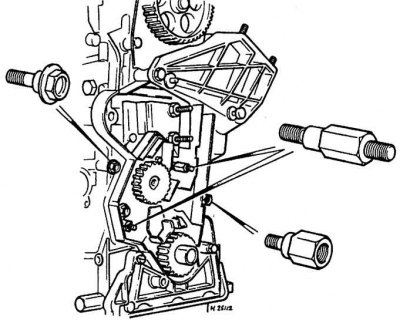
Special mounting posts for the rear part of the toothed belt drive guard
Cylinder head
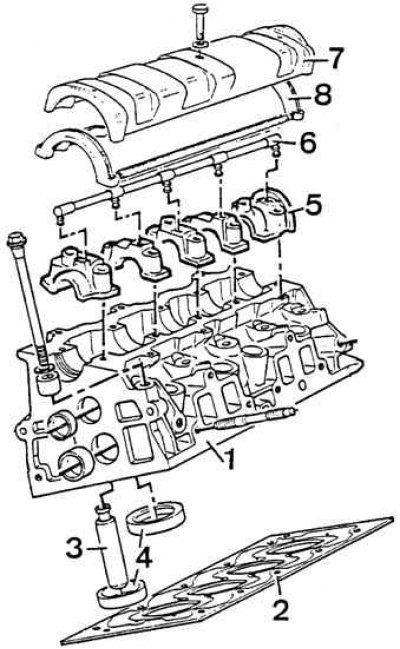
1 - cylinder head, 2 - cylinder head gasket, 3 - valve guide, 4 - valve seat, 5 - camshaft bearing cover, 6 - oil line, 7 - camshaft cover, 8 - gasket
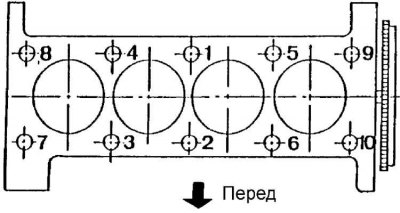
Cylinder head bolt tightening sequence
Removal
8-valve engine models
1. Remove the camshaft drive belt.
2. Drain the fluid from the cooling system.
3. Unscrew the lower support nut.
4. Remove the air filter assembly and air ducts.
5. Remove the distributor cap and spark plug wire harness.
6. Remove the fuel pump.
7. Unscrew the nut of the elastic support of the right upper engine bracket.
8. Raise the engine to a height of 6–8 cm. If using a lift, the hood must be installed vertically.
9. Unscrew the bolts securing the right upper bracket to the engine.
10. Lower the engine, making sure that the right upper bracket is on the elastic support.
11. Disconnect coolant lines, fuel lines and electrical connectors.
12. Disconnect the accelerator pedal cable.
13. Disconnect the exhaust system components near the manifold.
14. Unscrew the bolt securing the oil filler neck to the exhaust manifold.
15. Remove the diagnostic connector and the oil level indicator guide.
16. Remove the camshaft cover.
17. Loosen and unscrew in the reverse order of tightening the 10 cylinder head mounting bolts (see figure Cylinder head bolt tightening sequence).
18. Remove the cylinder head.
19. Install the flanges holding the cylinder liners (fixture 8.0132 AIZ together with bolt 0153 J).
Models 1905 cc with 16 valves
1. Remove the cylinder head cover.
2. Remove the ground wire from the battery.
3. Remove the bolt from the plastic cover of the power steering pump pulley.
4. Remove the drive belt from the steering drive pulley.
5. Unscrew the bolt and remove the pulley from the end of the camshaft.
6. Remove the electrical wires from the cylinder head.
7. Remove the coolant hoses from the cylinder head.
8. Remove the ignition distributor.
9. Remove the exhaust manifold.
10. Remove the timing belt.
11. Loosen the ten cylinder head mounting bolts evenly and in a specific sequence (in one pass for half a turn) until all bolts can be loosened by hand.
12. Remove the cylinder head.
Caution! Do not turn the crankshaft with the cylinder head removed, otherwise wet cylinder liners may be pushed out of the cylinder block.
13. If the cylinder head is removed for major repair, remove the camshafts from the cylinder head.
1998cc 16 valve models
The cylinder head removal process is the same as for the 1905cc 16-valve model (see above) except for the following changes:
- if necessary, remove both camshafts;
- when removing the intake manifold, disconnect the control unit;
- unscrew the bolt securing the oil dipstick tube from the cylinder head.
Lubrication channel filter
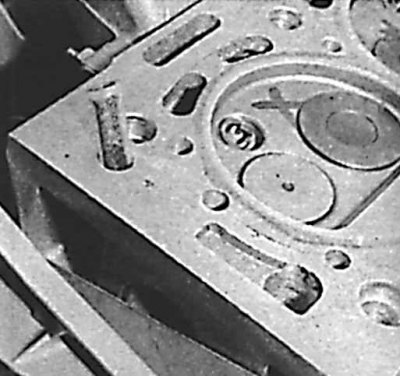
This filter should be replaced regularly.
Installation
1. Check the condition of the cylinder head mounting bolts, especially their threads. Check each bolt for visible wear or damage, replacing them if necessary.
2. If the length of the bolts is less than 122.0 mm, they can be reused. However, if at least one of the bolts is longer, the bolts must be replaced as a set.
Attention! It is recommended to replace the lubrication channel filter regularly.
3. Clean the connection surfaces with a special cleaning agent (for example, Magnus Magstrip or Decaploc 88).
4. Under no circumstances should you scrape the surfaces of the aluminum parts.
5. Clean the threads of the holes in the cylinder block using a tap M11x150 mm.
6. The mating surfaces of the cylinder head and block must be completely clean. Use a hard plastic or wooden scraper to clean them. Be careful when cleaning, as the aluminum alloy is very easy to damage. Check that carbon deposits have not entered the oil and water passages, this is especially important for the lubrication system, as carbon deposits can block the supply of oil to engine components. Clean the passages if necessary.
7. Check the mating surfaces of the cylinder head and block for nicks, deep scratches and other damage. If the defects are small, they can be removed by mechanical treatment, but if the defects are significant, the parts must be replaced.
8. Using a metal ruler and feeler gauge, check the flatness of the mating surfaces.
9. Clean the bolt holes in the block. Driving a bolt into an oil filled hole can cause the block to burst due to hydraulic pressure.
8-valve engine models
Identifying Cylinder Head Gaskets
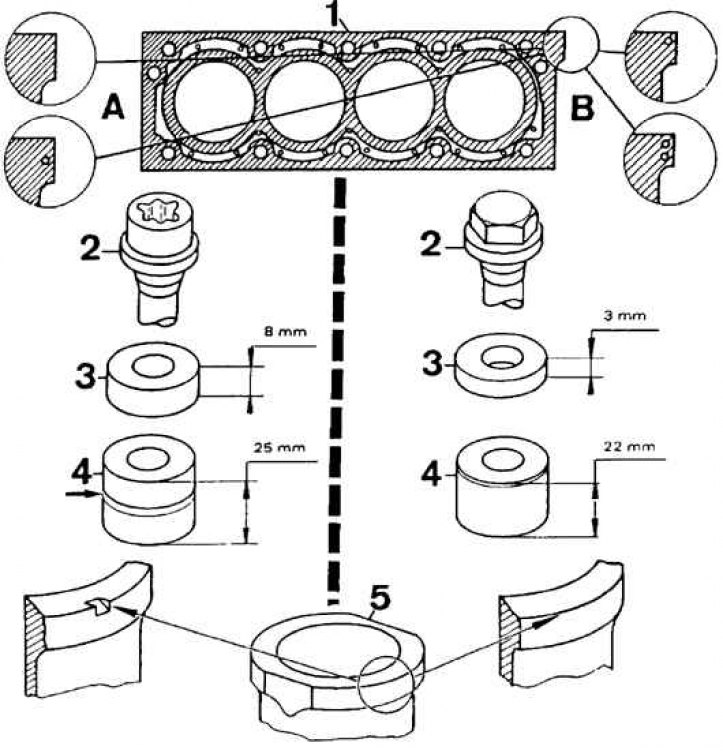
A – the type currently in use,
B – type used in some early models,
1 – cylinder head gasket, 2 – cylinder head mounting bolt, 3 – linings for cylinder head mounting bolts, 4 – spacer sleeve near coolant pump, 5 – cylinder liner
1. Remove the flanges holding the cylinder liners.
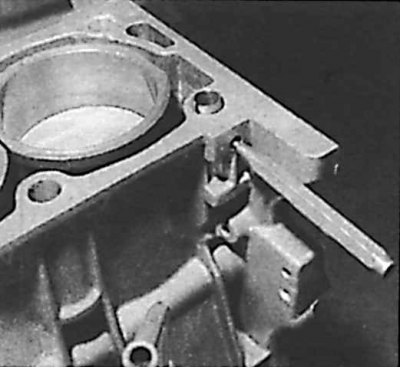
2. Using puller 8.0134 L, pull out the cylinder head installation pin on the left side. Set the pin in the upper position by inserting a pin punch with a diameter of 5 mm.
3. Check if the second pin on the right is installed.
4. Install the cylinder head gasket with the protrusion towards the clutch. The thickness of the new gasket is 1.2 mm in engines with an unground cylinder head and 1.4 mm in engines after reground head, indicated by the symbol R in front of bolt No.10. The 1.4 mm thick gasket is indicated by a special cutout on the protrusion (see figure Identification of cylinder head gaskets).
5. Insert the plastic filter into its socket.
6. Install the cylinder head.
7. Remove the punch.
8. Clean and lubricate the threads of ten bolts, insert them together with the washers into the corresponding holes. The bolt equipped with a spacer sleeve has the number 8 in accordance with the tightening order.
10. Pre-tighten the bolts to 80 Nm in the sequence shown (see figure Cylinder head bolt tightening sequence).
11. Raise the engine and install the two right engine bracket mounting bolts in the cylinder head. Tighten the bolts to 20 Nm.
12. Loosen the right engine bracket mounting bolt in the cylinder block.
13. Lower the engine (the right upper bracket should be on the elastic support).
14. Tighten the right engine bracket nut in the cylinder block and the connecting clamp nut to a torque of 35 Nm.
15. Loosen cylinder head bolt #1 completely and tighten to 20 Nm. Use 8.0154 bushing and tighten the bolt to an angle of 120° (hex bolt) or at an angle of 300° (Torx bolt).
16. Repeat these operations for each of the remaining bolts in the order indicated.
17. Check the valve clearance and adjust if necessary.
18. Install the cylinder head cover.
19. Install the oil level indicator guide and diagnostic connector.
20. Secure the oil filler neck to the intake manifold.
21. Secure the exhaust system components.
22. Connect the accelerator cable, coolant lines, fuel lines and electrical connectors.
23. Install the camshaft drive belt.
24. Fill the cooling system with coolant.
25. If a new camshaft drive belt is installed, its tension must be readjusted after the engine has cooled.
26. Tighten the cylinder head (additional operation, necessary only when using hexagon head bolts). To do this you should:
- remove the cylinder head cover;
- completely loosen mounting bolt No.1 and tighten it to a torque of 20 Nm;
- you should use a bushing and tighten the bolt to an angle of 120°;
- repeat these steps for each of the remaining bolts in the order given.
27. Check the valve clearance and adjust if necessary.
28. Install the cylinder head cover.
29. Tighten the right engine bracket mounting bolt to the cylinder block to 20 Nm. Do not tighten the cylinder head mounting elements any further.