



Table of contents: Checking the pressure of the…🠇 Checking the tightness of the…🠇
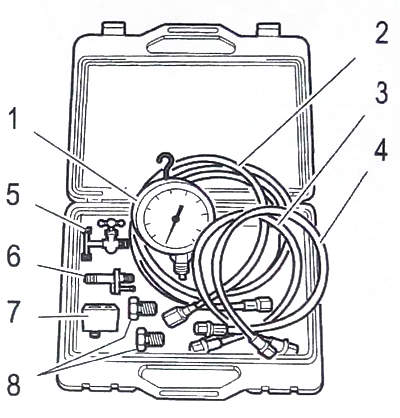
Special devices for checking the pressure in the power steering circuit:
1 - pressure gauge 0710.AZ;
2 - branch pipe for testing with a pressure gauge with a tap 0710. B1;
3 - branch pipe for testing high pressure hose with tap 0710.B2;
4-pipe for checking the high-pressure pump with tap 0710. VZ;
5 - three-way valve 0710.C;
6 - nipple 0710.J;
7 - nipple 0710.K;
8 - plugs for checking the tightness of the distributor 0710.N.
Caution: Open the circuit carefully to prevent contamination particles from entering it.
Note: Proper operation of the device requires exceptional cleanliness/of the power steering fluid and hydraulic components.
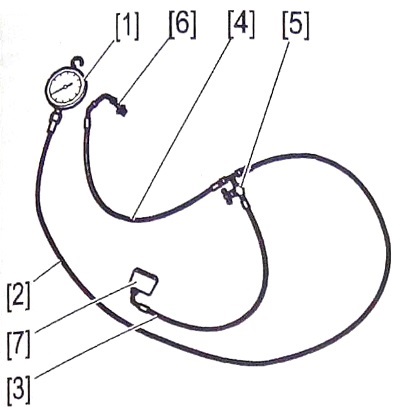
Check the power steering fluid level and the condition of the tubes and couplings. Prepare and assemble the test kit by connecting the devices according to the diagram shown in the figure below.
Hang the fixture 1.
 |
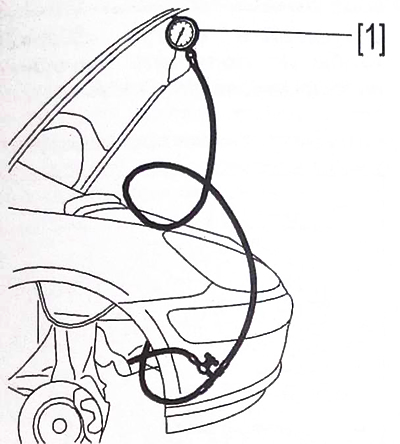 |
Remove:
- front right wheel;
- right front fender liner;
- washer reservoir.
Move the high pressure line (1) to the side.
Screw in:
- nipple 6 for the electric power steering pump;
- nipple 7 on the high pressure pipeline (1).
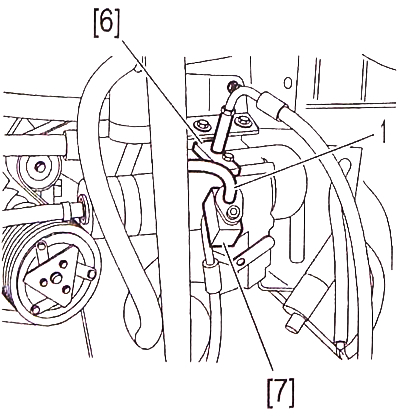
Tighten all connections.
Fill the power steering reservoir to 10 mm below the maximum mark.
Attention: Use new working fluid to replace and refill the system.
Open tap 5.
Start the engine and let it run for five seconds.
Turn off the engine.
Turn the steering wheel several times in both directions.
Check the power steering fluid level and check for leaks.
Checking the pressure of the electric pump
Start the engine.
Close tap 5 for five seconds.
Open tap 5.
Turn off the engine.
At fast idle speed (1200-1500 rpm) the pressure should be 105 ±5 bar.
If the electric pump pressure is normal, check the tightness of the distributor.
Checking the tightness of the distributor
Remove the lower powertrain guard.
Move the steering gear heat shield.
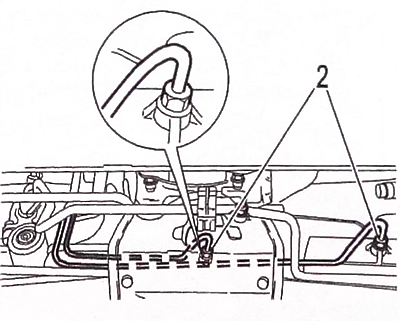
Loosen the fittings (2) on the steering gear working hydraulic cylinder.
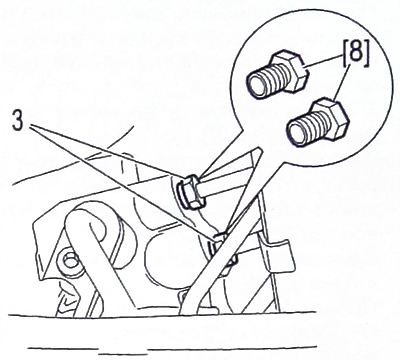
Disconnect the two supply lines (3) from the distribution valve and move them to the side.
Install plugs 8 on the distribution valve (2) and tighten to a torque of 8 Nm.
Move the steering wheel slowly from end to end to empty the cylinder.
Add fluid to the power steering reservoir.
Open tap 5.
Start the engine.
Keep the engine running at accelerated idle speed.
Keep the wheels turned all the way to one side, then to the other. The pressure should stabilize within 105 ±5 bar.
If the pressure is normal: replace the steering gear.
If the pressure is below the above values: replace the control valve.
Connect the two supply lines (3) to the distribution valve and tighten to 8 Nm. Screw in the fittings (2) on the steering gear hydraulic cylinder and tighten to 8 Nm.
Remove:
- nipple 7 from high pressure pipeline (1);
- nipple 6 from the electric power steering pump.
Install:
- high pressure pipeline (1);
- washer reservoir;
- right front fender liner;
- front right wheel.
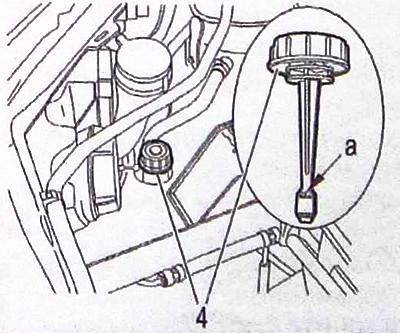
Fill the power steering fluid reservoir to the maximum mark "a" of the plug (4).
With the engine off, slowly turn the steering wheel from one extreme position to the other (about 10 times).
Add fluid up to the "a" mark on the dipstick (4).
Start the engine and let it idle for three minutes without operating the steering wheel.
Add fluid as the level drops.
Bleed the hydraulic system by turning the steering wheel all the way in each direction several times. Add fluid as the level drops.
Caution: Use certified power steering fluid when filling and topping up the circuit.