
English Русский
Български
Беларускі
Український
Српски
Hrvatski
Română
Polski
Slovenský
Magyar
Bookmark Articles Sitemap Contacts
Company Hyundai Company Opel Company Skoda Company Kia Company Mitsubishi Company LADA Company Audi
PeugeotBook.ru


Series 100   Series 200   Series 300   400-500   Series 600   Crossovers   Others
 
Peugeot 305 (1977-1989) Peugeot 306 (1993-2002) Peugeot 307 (2001-2008)

Replacing the clutch disc (Peugeot 307)

  • Main
  • 30X
  • Peugeot 307 (2001-2008)
  • Transmission
  • Clutch and drive shafts
  • Replacing the clutch disc
0
To remove the clutch disc:
  • remove the gearbox;
  • mark the position of the clutch assembly in relation to the flywheel with a marker or paint;
  • using a special tool or a screwdriver, lock the flywheel ring gear teeth to prevent it from turning;
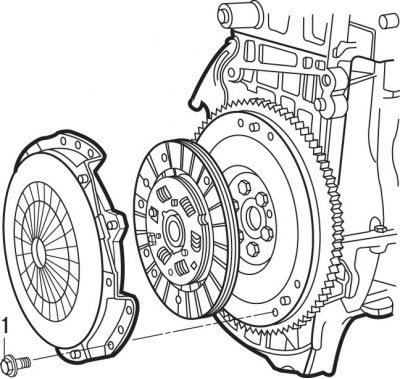
Figure 5.9. Location of the clutch mounting bolt (1)

Figure 5.9. Location of the clutch mounting bolt (1)

  • gradually loosen bolts diagonally 1 (figure 5.9) clutch assembly mountings by turning each bolt half a turn until the spring force is released and the bolts can be loosened by hand;
  • remove the pressure plate, while supporting the driven plate so that it does not fall out;
  • clean the clutch release bearing from dirt, but do not use solvents;
  • wipe the flywheel with gasoline.

To check the serviceability of the clutch disc:
  • check the condition of the clutch pressure plate. Traces of wear on the ends of the pressure spring should be no more than 0.3 mm;
  • check the reliability of the spring connection between the pressure plate and the clutch housing. Scratches and missing or damaged rivets are not allowed;
  • check the pressure plate for cracks, burns, and surface wear;
  • using a steel ruler and a feeler gauge blade, check the flatness of the pressure plate working surface. The flatness of the pressure plate should not exceed 0.2 mm;
  • check the condition of the flywheel friction surface for cracks, burns and surface wear;
  • check the condition of the friction linings of the driven clutch disc and if there are traces of oil or mechanical damage, replace the driven disc;
  • measure the thickness of the clutch driven disc linings. If their thickness is less than the permissible value or if the rivet heads are close to the working surface, replace them or the clutch driven disc;
  • check the condition of the release bearing, which should rotate easily, evenly and quietly and there should be no play in it. The working surface of the bearing acting on the compression spring must be smooth, without cracks, local corrosion or wear;
  • a faulty clutch release bearing can be identified without removing it from the vehicle by pressing the clutch pedal while the engine is running. If noise occurs when you press the clutch pedal, the clutch release bearing is faulty and needs to be replaced;
  • if there is oil in the clutch housing, the rear crankshaft sealing ring must be replaced.

To install the clutch disc:


  • lubricate the splines in the driven disk hub with a thin layer of special grease based on molybdenum disulfide;

Note: When installing a new driven disc or pressure plate, remove the anti-corrosion protection from them.

  • install the driven disc onto the flywheel so that the spring of the disc shock-absorbing hub is directed outward, towards the gearbox;
  • when reinstalling a previously removed clutch pressure plate, check that the marks made before removal are aligned;

Caution! The lubricant layer must be thin and even, otherwise, when the clutch is operating, excess lubricant will be thrown onto the clutch working surfaces, which may impair its operation. When installing the driven disk, make sure that no oil gets on its friction linings, even in small quantities. Therefore, before installation, wipe the mating surface of the flywheel and the surface of the pressure plate with a clean rag, install the driven disk with clean hands.

  • tighten the clutch mounting bolts so that the driven clutch disc is pressed, but at the same time can still move to the sides;
  • using a special tool 0213/0214 or the old primary shaft of the gearbox, center the clutch disc relative to the flywheel;
  • after centering the driven disk, gradually tighten the clutch housing mounting bolts diagonally to a torque of 20 N·m;
  • remove the mandrel from the driven disk;
  • lubricate the splined portion of the gearbox input shaft, the clutch release bearing guide sleeve and the fork tips with a thin layer of MOLYKOTE BR2 PLUS special grease;
  • install the clutch release bearing;
  • install the gearbox.
This article is available at russian, bulgarian, belarusian, ukrainian, serbian, croatian, romanian, polish, slovak, hungarian
Article reviewed by editor: Sidorov Timofey
Share information:
Previous
Peugeot 307: Clutch and drive shafts
Next

Replacing the hydraulic clutch drive
General information about the clutch
General information about drive shafts
Replacing axle shafts
Replacement of constant velocity joints
Replacing the intermediate bearing of the right axle shaft
See similar information for other Peugeot models

➨ Clutch adjustment check and control mechanism lubrication Peugeot 106 (1991-2003)
➨ Brake and Clutch Hydraulic Fluid Peugeot 207 (2006-2014)
➨ Replacing the clutch disc or leading part Peugeot 405 (1987-1997)
➨ Engine Oil Level — Checking and Replacing Peugeot 605 (1989-2000)
➨ Front disc brakes — replacing brake pads Peugeot 806 (1994-2002)
Link to this article in different formats
Comments and feedback from visitors
No comments yet


Add two numbers 23 + 31


Peugeot 307 (2001-2008) 
  • User manual
  • Keys, doors and alarm
  • Controls and instruments
  • Driving and operation
  • Maintenance
  • Power unit
  • Petrol engines TU3 and TU5
  • Petrol engines EW10
  • Diesel engines DV10
  • Diesel engines DW10
  • Transmission
  • Clutch and drive shafts
  • Mechanical gearbox
  • Automatic gearbox
  • Chassis, running gear
  • Front suspension
  • Rear suspension
  • Steering
  • Brake system
  • Body and interior
  • Exterior (external elements)
  • Interior (internal elements)
  • Doors, locks and windows
  • Heating and air conditioning
  • Electrical equipment
  • Equipment and devices
  • Power devices
  • Airbags
  • Electrical circuits
Peugeot 306 (1993-2002) 
  • General information
  • Introduction to manual
  • Specifications
  • Gasoline engine
  • Engine repair
  • Lubrication system
  • Cooling system
  • Fuel injection
  • Ignition system
  • Diesel engine
  • Engine repair
  • Lubrication system
  • Cooling system
  • Fuel injection
  • Transmission
  • Clutch
  • Gearbox
  • Drive shafts
  • Chassis, running gear
  • Steering system
  • Front suspension
  • Rear suspension
  • Brake system
  • Electrical equipment
  • Power devices
  • Electrical circuits
Peugeot 305 (1977-1989) 
  • General information
  • Maintenance
  • Power unit
  • Gasoline engines
  • Diesel engines
  • Cooling system (gasoline)
  • Cooling system (diesel)
  • Fuel system (gasoline)
  • Fuel system (diesel)
  • Ignition system
  • Transmission
  • Clutch
  • Mechanical gearbox BB8
  • Mechanical gearbox BE1
  • Automatic gearbox ZF4
  • Shafts, hubs and wheels
  • Chassis, running gear
  • Brake system
  • Car suspension
  • Steering
  • Body and interior
  • Exterior (external elements)
  • Interior (internal elements)
  • Electrical equipment
  • Equipment and devices
  • Headlights and lighting
  • Power devices
  • Electrical circuits
  • Wiring diagrams (diesel)
PeugeotBook.ru © 2018–2026 | Mobile version | Sitemap: EN BG BY UA RS HR RO PL SK HU | Write message | Site search | Add to bookmarks | Peugeot owners
106 (1991-2003) | 206 (1998-2012) | 207 (2006-2014) | 305 (1977-1989) | 306 (1993-2002) | 307 (2001-2008) | 405 (1987-1997) | 406 (1995-2004) | 605 (1989-2000) | Partner-I (1996-2008) | Eurovans-807 (2002-2014) | Eurovans-806 (1994-2002) | J5 (1981-1993) |
Cookies are used to ensure the correct display of pages on the site.