
English Русский
Български
Беларускі
Український
Српски
Hrvatski
Română
Polski
Slovenský
Magyar
Bookmark Articles Sitemap Contacts
Company Hyundai Company Opel Company Skoda Company Kia Company Mitsubishi Company LADA Company Audi
PeugeotBook.ru


Series 100   Series 200   Series 300   400-500   Series 600   Crossovers   Others
 
Peugeot 305 (1977-1989) Peugeot 306 (1993-2002) Peugeot 307 (2001-2008)

Water pump — removal and installation (Peugeot 306)

  • Main
  • 30X
  • Peugeot 306 (1993-2002)
  • Gasoline engine
  • Cooling system
  • Water pump — removal and installation
0
The water pump is not repairable and must be replaced if damaged, however the impeller assembly, cover and housing can be replaced separately. If leaks occur, replace the O-ring or impeller. The water pump is driven by a toothed belt. This means that the timing drive must be removed before accessing the water pump. This also requires pins to lock the timing mechanism. The pump can be removed provided that locking pins can be purchased or made independently.
  • Drain the coolant from the cooling system (section 4.1) or disconnect the lower water hose and drain the coolant. Pour the liquid that looks good into an appropriate container.
  • Unscrew the timing belt protective covers from the front of the engine. The two bolts located above the crankshaft belt pulley do not need to be unscrewed.
  • Remove the timing belt following the instructions for the appropriate engine and support the right side of the engine with a jack (place a wooden block between the jack and the engine). Slowly raise the engine until the suspension is relieved. Remove the suspension from this side.
  • Disconnect the water hoses from the water pump and remove the pump mounting bolts. Remove the water pump from the cylinder block. There is a circular sealing ring under the pump (tU type engines) or gasket (xU type engines). They must be replaced.

On a TU type engine, the water pump can be partially disassembled to replace both internally located O-rings, the impeller assembly, or the pump cover. The disassembled pump is shown in Figure 160. Insert new O-rings into the grooves and reassemble the pump. Tighten the upper bolts to 16 Nm and the lower bolts to 7 Nm.


The water pump on XU type engines is replaced as a single unit.

Installation of the assembled water pump is carried out in reverse order. Before installation, check that both pump centering pins are in the cylinder block (CU). Insert a new O-ring into the cylinder block and install the housing. Insert the bolts and tighten them to the specified tightening torque for TU type engines. Tighten bolts (2) in Figure 161 to 30 Nm and bolts (3) to 65 Nm. Connect the water hoses. Install the timing belt following the instructions section 2.3 for engine assembly. After this, tighten the engine mount to a torque of 45 Nm, add coolant to the cooling system and, after running the engine for some time, check for leaks.

On a Type XII engine, the 5 bolts shown in Figure 162 are tightened to a torque of 15 Nm. The pump gasket must be replaced.

The water pump of the TU engine can also be partially removed, i.e. the impeller unit or cover can be removed separately when, for example, only the O-ring needs to be replaced. In this case, the coolant is drained and the toothed belt is removed, as when completely removing the water pump.
  • To remove the impeller assembly, unscrew the two bolts (1) and (2) (Figure 163). Remove the impeller assembly (3). Insert a new O-ring into the groove and reinstall the impeller assembly.

[Source available here: peugeotbook.ru]
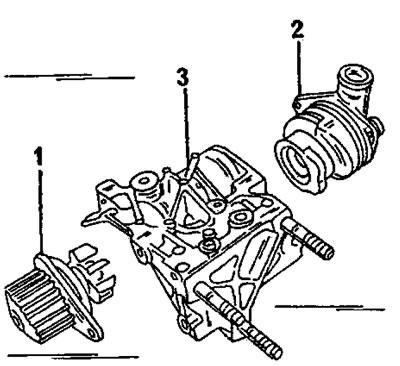

Figure 160. Parts of the water pump of the TU type engine. 1. Impeller assembly; 2. Housing cover;…

Figure 160. Parts of the water pump of the TU type engine. 1. Impeller assembly; 2. Housing cover; 3. Water pump housing
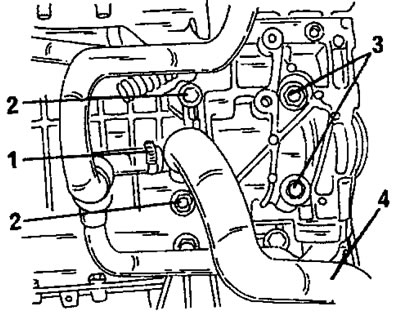


Figure 161. Installing a water pump on a TU type engine. 1. Water hose nipple; 2. Bolt, 30 Nm; 3.…

Figure 161. Installing a water pump on a TU type engine. 1. Water hose nipple; 2. Bolt, 30 Nm; 3. Bolt, 65 Nm; 4. Water hose
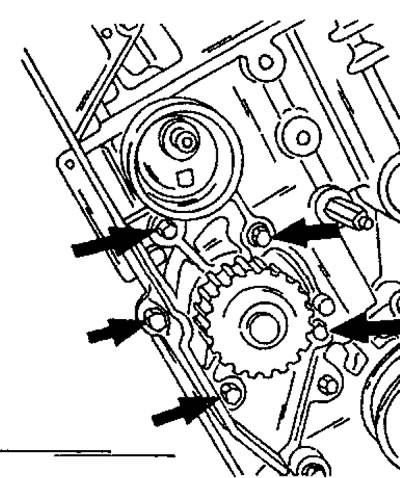

Figure 162. The arrows indicate the water pump mounting bolts on the XU type engine.
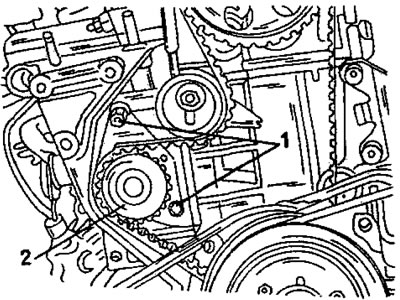
Figure 162. The arrows indicate the water pump mounting bolts on the XU type engine.


Figure 163. Removing the impeller assembly (see text).

Figure 163. Removing the impeller assembly (see text).


Tighten bolt (1) to a torque of 16 Nm and bolt (2) to a torque of 7 Nm. Install the timing belt following the engine assembly instructions.
  • To replace the housing cover (2) in Figure 160, the toothed belt does not need to be removed. However, the coolant must be drained. Remove the cover and pull the O-ring out of the groove. Place a new O-ring into the groove and reinstall the cover onto the water pump housing. The bolts are tightened to a torque of 7 Nm.
This article is available at russian, bulgarian, belarusian, ukrainian, serbian, croatian, romanian, polish, slovak, hungarian
Article reviewed by editor: Shirokov Arseny
Share information:
Previous
Peugeot 306: Cooling system
Next

Radiator — removal and installation
Draining and filling coolant
General information about the engine cooling system
Drive belt tension
Cooling system fan
Thermostat — installation
Antifreeze — general information
Connecting the heater hoses
See similar information for other Peugeot models

➨ Fuel filter water draining Peugeot 106 (1991-2003)
➨ Turbocharger Cooling Pump Replacement (EP6DT Engines) Peugeot 207 (2006-2014)
➨ Water pump — removal and installation Peugeot 406 (1995-2004)
➨ Water Pump — Removal Peugeot 605 (1989-2000)
➨ Water pump — removal and installation Peugeot 806 (1994-2002)
Link to this article in different formats
Comments and feedback from visitors
No comments yet


Add two numbers 25 + 26


Peugeot 307 (2001-2008) 
  • User manual
  • Keys, doors and alarm
  • Controls and instruments
  • Driving and operation
  • Maintenance
  • Power unit
  • Petrol engines TU3 and TU5
  • Petrol engines EW10
  • Diesel engines DV10
  • Diesel engines DW10
  • Transmission
  • Clutch and drive shafts
  • Mechanical gearbox
  • Automatic gearbox
  • Chassis, running gear
  • Front suspension
  • Rear suspension
  • Steering
  • Brake system
  • Body and interior
  • Exterior (external elements)
  • Interior (internal elements)
  • Doors, locks and windows
  • Heating and air conditioning
  • Electrical equipment
  • Equipment and devices
  • Power devices
  • Airbags
  • Electrical circuits
Peugeot 306 (1993-2002) 
  • General information
  • Introduction to manual
  • Specifications
  • Gasoline engine
  • Engine repair
  • Lubrication system
  • Cooling system
  • Fuel injection
  • Ignition system
  • Diesel engine
  • Engine repair
  • Lubrication system
  • Cooling system
  • Fuel injection
  • Transmission
  • Clutch
  • Gearbox
  • Drive shafts
  • Chassis, running gear
  • Steering system
  • Front suspension
  • Rear suspension
  • Brake system
  • Electrical equipment
  • Power devices
  • Electrical circuits
Peugeot 305 (1977-1989) 
  • General information
  • Maintenance
  • Power unit
  • Gasoline engines
  • Diesel engines
  • Cooling system (gasoline)
  • Cooling system (diesel)
  • Fuel system (gasoline)
  • Fuel system (diesel)
  • Ignition system
  • Transmission
  • Clutch
  • Mechanical gearbox BB8
  • Mechanical gearbox BE1
  • Automatic gearbox ZF4
  • Shafts, hubs and wheels
  • Chassis, running gear
  • Brake system
  • Car suspension
  • Steering
  • Body and interior
  • Exterior (external elements)
  • Interior (internal elements)
  • Electrical equipment
  • Equipment and devices
  • Headlights and lighting
  • Power devices
  • Electrical circuits
  • Wiring diagrams (diesel)
PeugeotBook.ru © 2018–2026 | Mobile version | Sitemap: EN BG BY UA RS HR RO PL SK HU | Write message | Site search | Add to bookmarks | Peugeot owners
106 (1991-2003) | 206 (1998-2012) | 207 (2006-2014) | 305 (1977-1989) | 306 (1993-2002) | 307 (2001-2008) | 405 (1987-1997) | 406 (1995-2004) | 605 (1989-2000) | Partner-I (1996-2008) | Eurovans-807 (2002-2014) | Eurovans-806 (1994-2002) | J5 (1981-1993) |
Cookies are used to ensure the correct display of pages on the site.