



2. Remove the brake pads.
3. Replace the front wheels and lower the car to the ground. Push it back and forth several times, while steering and rocking the car at the same time, to get the suspension parts into place. (Do not press the brake pedal, as this may cause the pistons to fall out of the caliper).
 |
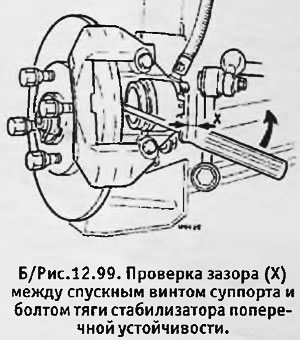 |
4. Turn the steering wheel all the way to the left. Move the left brake caliper all the way toward the stabilizer bar and check that there is a gap between the caliper bleed screw and the stabilizer bar link bolt. Turn the steering wheel all the way to the right and repeat the check on the right caliper.
5. If both bleed screws do not touch the stabilizer link bolts, you can assume that the stabilizer is well centered and proceed to paragraph 10. If both screws touch the bolts, this means that the stabilizer is deformed and must be replaced. If only one screw is touching the bolt, you need to do the following.
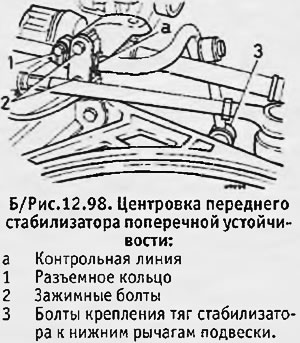
6. Draw or scratch a line on the stabilizer next to one of the clamps so that you can see how much the stabilizer moves.
7. Loosen the stabilizer split ring and the clamp bolts and nuts on both sides. Also loosen the bolts securing the stabilizer links to the lower suspension arms.
8. Move the stabilizer to the side opposite to where the bolt contacts the bleed screw. Tighten nuts and bolts to the specified torque in the following sequence:
- a. Split ring nuts
- b. Clamping nuts and bolts
- c. Bolts securing the stabilizer links to the lower suspension arms.
9. Repeat the check specified in paragraph 4.
10. Raise the car and remove the front wheels. Install the brake pads in place.
11. Replace the front wheels and lower the car. Tighten the wheel nuts or bolts. Press the brake pedal several times to press the pads against the discs.
12. Check the brake fluid level and top up if necessary.