



Table of contents: Checking the cylinder mirror (glossy…🠇 Visible risks, traces of friction 🠇 Ring-shaped impressions 🠇 Shiny, reflective, polished areas…🠇 Rough marks, frictional scuffs 🠇 Individual continuous scratches 🠇 Piston scuffing 🠇 Darkening of the cylinder surface 🠇
Note: The repair procedures described here are for 2.0L four-cylinder petrol and diesel engines. The procedures for smaller displacement engines are similar. Technical information on the cylinder block components and the cylinder head as a whole is provided in Chapter "Data for adjustments and control of the mechanical part of gasoline and diesel engines".
Checking the cylinder mirror (glossy areas, scuffs)
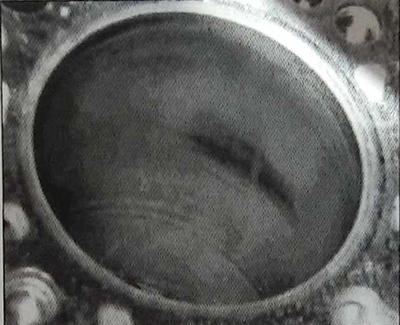
Individual shiny areas, such as in the middle of the cylinder or in the area of the cylinder head bolts, should not cause concern. In this case, the cylinder block can be reused.
Visible risks, traces of friction
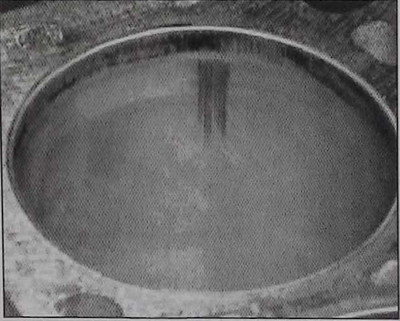
They appear as emanating from the top dead center zone of the upper piston ring and descending downwards and are the result of dry friction that occurs as a result of fuel washing off the oil film, for example, during frequent starts of a cold engine in the mode of operating the vehicle over short distances.
These "smoothed" traces of friction, which appear on the cylinder mirror mainly in the area of the cylinder head bolts and in the area of lateral pressure of the piston skirt, are within normal limits.
If the piston rings are not damaged, the cylinder block is suitable for further use.
Ring-shaped impressions
They appear as visible marks on the cylinder mirror in the area of the upper and lower dead centers of the piston rings and are also not critical. In this case, the cylinder block is also suitable for further use.
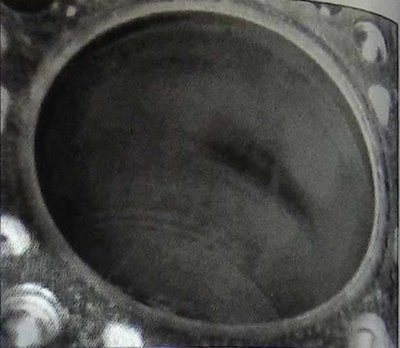
Shiny, reflective, polished areas around the circumference of the cylinder mirror
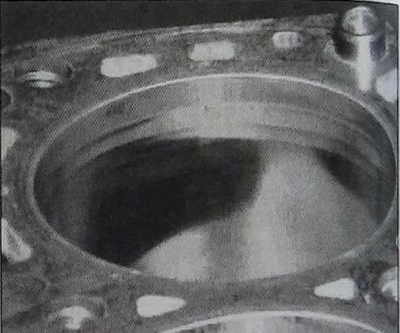
They appear as traces emanating from the top dead center zone of the upper piston ring and are usually accompanied by partial wear of the cylinder. In this case, the cylinder mirror is unsuitable for further use (repair or replace the cylinder block).
Rough marks, frictional scuffs
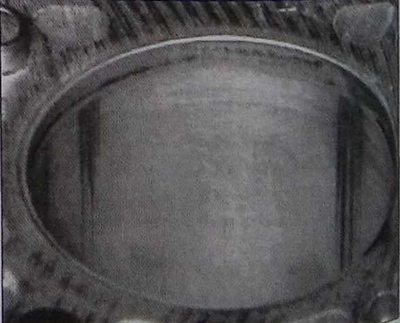
Traces that start from the first and second piston rings and taper off only at the bottom of the cylinder. Such progressive friction marks lead to the formation of friction scuffs.
If such traces are noticeable (for example, they are felt when touched), the cylinder mirror is unsuitable for further use (repair or replace the cylinder block).
Note: This defect may damage piston rings.
Individual continuous scratches
Typically occurs when dirt gets into the combustion chamber, for example as a result of back pulsation of soot particles from the exhaust system. In this case, the cylinder block can be reused.
Piston scuffing
With this defect, as a rule, the cylinder mirror has a noticeable roughness along the entire length, there are also noticeable distortions of the material and tangible traces of scoring on the cylinder mirror and piston skirt. In this case, the cylinder mirror is unsuitable for further use (repair or replace the cylinder block).
(Article based on material from the website: PEUGEOTBOOK)
Darkening of the cylinder surface
Darkening on large areas of the cylinder mirror is oil "varnish" deposits and indicates engine operation in high-temperature conditions. In this case, the cylinder block is suitable for further use in the absence of unacceptable deformation of the cylinders. Oil "varnish" deposits over the piston ring area are considered normal and should not be considered a malfunction.