
English Русский
Български
Беларускі
Український
Српски
Hrvatski
Română
Polski
Slovenský
Magyar
Bookmark Articles Sitemap Contacts
Company Hyundai Company Opel Company Skoda Company Kia Company Mitsubishi Company LADA Company Audi
PeugeotBook.ru


Series 100   Series 200   Series 300   400-500   Series 600   Crossovers   Others
 
Peugeot 305 (1977-1989) Peugeot 306 (1993-2002) Peugeot 307 (2001-2008)

Cylinder head assembly (Peugeot 306)

  • Main
  • 30X
  • Peugeot 306 (1993-2002)
  • Diesel engine
  • Engine repair
  • Cylinder head assembly
0
If the cylinder head is replaced, all parts are transferred from the old cylinder head to the new one. Thoroughly clean all parts and generously lubricate all moving and rotating parts with engine oil.
  • Insert the valves into the guide bushings. If the valve seats have been ground, they should be installed in the corresponding seats in the cylinder head. The same applies to re-installed valves, which must be put back in their original locations.
  • Thoroughly clean the threaded holes under the cylinder head. The holes must be degreased. If necessary, you can go through the threads with an M12 x 150 tap. After this, clean the threaded holes.
  • Using Figure 374, install new valve stem seals on each valve guide.
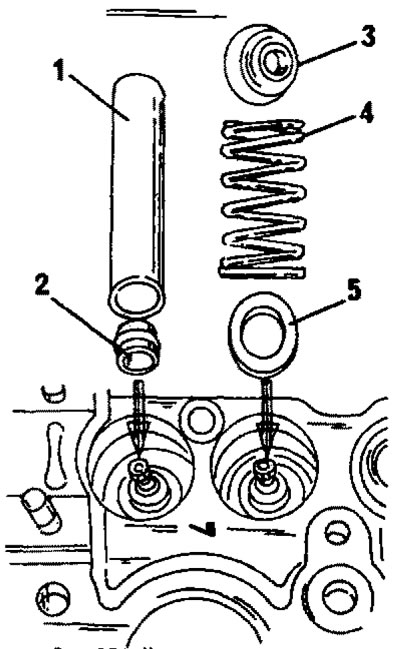
Figure 374. To install valves. 1. Tube for installing oil deflector caps; 2. Oil deflector cap; 3.…

Figure 374. To install valves. 1. Tube for installing oil deflector caps; 2. Oil deflector cap; 3. Valve spring cup; 4. Valve spring; 5. Washer

  • Push in the valves (generously lubricated with motor oil) from the bottom of the cylinder head and place the parts shown in Figure 374 on them from the top. To do this, place springs on each valve and compress them with a valve puller. When the end of the valve stem begins to protrude from the top of the valve spring plate, insert crackers with sharp tweezers. Slowly release the valve puller and check if the crackers are held securely in the valves.
  • Tap the top of each valve stem with a plastic hammer. Loosely seated crackers will pop out. As a precaution, place a rag on the ends of the springs to prevent the parts from flying apart.
  • Lubricate the camshaft bearing journals with engine oil and carefully insert the shaft into the cylinder head, without hitting the cams or journals on the bearing bushings. Install three camshaft bearing caps. The cover marked with the number "3" is installed on the toothed pulley side. Tighten the bearing cap nuts evenly to a tightening torque of 18 Nm.
  • Press both camshaft oil seals into the cylinder head using a suitable piece of pipe after the valve clearances have been adjusted according to the instructionssection 15.4.5.
This article is available at russian, bulgarian, belarusian, ukrainian, serbian, croatian, romanian, polish, slovak, hungarian
Article reviewed by editor: Shirokov Arseny
Share information:
Previous
Peugeot 306: Engine repair
Next

Disassembling the cylinder head
Cylinder head — removal
Engine assembly
Disassembling the engine
Installation of the power unit
Installing the cylinder head
Adjusting valve clearances
Pistons and connecting rods
Disassembling pistons and connecting rods
Checking pistons and connecting rods
See similar information for other Peugeot models

➨ Cylinder head cover — removal and refitting Peugeot 106 (1991-2003)
➨ Cylinder head (petrol engines 1.4 and 1.6 l, EPZ, TU5) Peugeot 207 (2006-2014)
➨ Removal the cylinder head Peugeot 405 (1987-1997)
➨ Cylinder head — removal Peugeot 605 (1989-2000)
➨ Cylinder head — removal and installation Peugeot 806 (1994-2002)
Link to this article in different formats
Comments and feedback from visitors
No comments yet


Add two numbers 43 + 36


Peugeot 307 (2001-2008) 
  • User manual
  • Keys, doors and alarm
  • Controls and instruments
  • Driving and operation
  • Maintenance
  • Power unit
  • Petrol engines TU3 and TU5
  • Petrol engines EW10
  • Diesel engines DV10
  • Diesel engines DW10
  • Transmission
  • Clutch and drive shafts
  • Mechanical gearbox
  • Automatic gearbox
  • Chassis, running gear
  • Front suspension
  • Rear suspension
  • Steering
  • Brake system
  • Body and interior
  • Exterior (external elements)
  • Interior (internal elements)
  • Doors, locks and windows
  • Heating and air conditioning
  • Electrical equipment
  • Equipment and devices
  • Power devices
  • Airbags
  • Electrical circuits
Peugeot 306 (1993-2002) 
  • General information
  • Introduction to manual
  • Specifications
  • Gasoline engine
  • Engine repair
  • Lubrication system
  • Cooling system
  • Fuel injection
  • Ignition system
  • Diesel engine
  • Engine repair
  • Lubrication system
  • Cooling system
  • Fuel injection
  • Transmission
  • Clutch
  • Gearbox
  • Drive shafts
  • Chassis, running gear
  • Steering system
  • Front suspension
  • Rear suspension
  • Brake system
  • Electrical equipment
  • Power devices
  • Electrical circuits
Peugeot 305 (1977-1989) 
  • General information
  • Maintenance
  • Power unit
  • Gasoline engines
  • Diesel engines
  • Cooling system (gasoline)
  • Cooling system (diesel)
  • Fuel system (gasoline)
  • Fuel system (diesel)
  • Ignition system
  • Transmission
  • Clutch
  • Mechanical gearbox BB8
  • Mechanical gearbox BE1
  • Automatic gearbox ZF4
  • Shafts, hubs and wheels
  • Chassis, running gear
  • Brake system
  • Car suspension
  • Steering
  • Body and interior
  • Exterior (external elements)
  • Interior (internal elements)
  • Electrical equipment
  • Equipment and devices
  • Headlights and lighting
  • Power devices
  • Electrical circuits
  • Wiring diagrams (diesel)
PeugeotBook.ru © 2018–2026 | Mobile version | Sitemap: EN BG BY UA RS HR RO PL SK HU | Write message | Site search | Add to bookmarks | Peugeot owners
106 (1991-2003) | 206 (1998-2012) | 207 (2006-2014) | 305 (1977-1989) | 306 (1993-2002) | 307 (2001-2008) | 405 (1987-1997) | 406 (1995-2004) | 605 (1989-2000) | Partner-I (1996-2008) | Eurovans-807 (2002-2014) | Eurovans-806 (1994-2002) | J5 (1981-1993) |
Cookies are used to ensure the correct display of pages on the site.